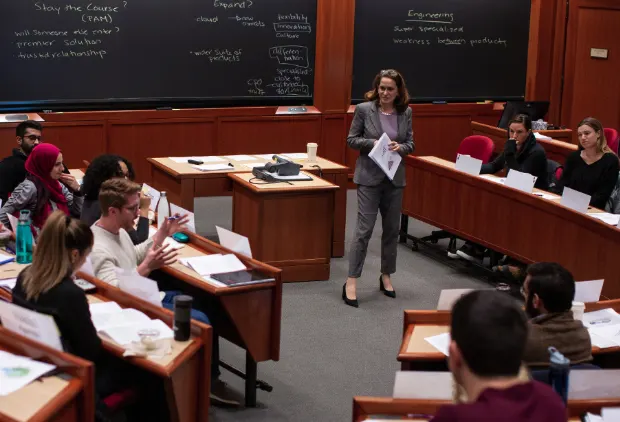
Harvard Business School requires students to take a class on the “purpose of the firm.” The course explores how and under what conditions corporations are best positioned to address some of society's greatest challenges, such as climate change, economic mobility, or racial and gender inequality. Using six linked cases, the course encourages students to think beyond the firm and its management to the broader question of what it means to make a difference in the world—and what it takes to do so.
BOSTON — In its mission to educate leaders who make a difference in the world, Harvard Business School has required first-year MBA students since 2022 to take a short class on the “purpose of the firm,” studying the role companies play in addressing a wide range of societal problems, from climate change to income inequality.
Organized by the Institute for Business in Global Society (BiGS), the interdisciplinary class was designed to explore how business leaders can harness the power of markets to address some of society’s most vexing problems—and how to navigate the public and private sector complications that inevitably arise in that endeavor.
While most courses at HBS take the perspective of the firm and its managers, Purpose of the Firm prompts students to consider a broader landscape. For example, how do the actions of private firms affect the societies in which they operate? How can business leaders use the vehicle of a private firm to tackle societal challenges such as climate change or socio-economic inequality? And how do leadership choices influence these goals?
“The hope here is that we introduce a course that forces students to grapple, at a most fundamental level, with what they're going to spend their lives doing,” said Debora Spar, professor and senior associate dean at Harvard Business School and head of the course. “Our students are here presumably because they want to change the world. They chose to come to business school as part of that mission.
"That creates the obvious question that thus far has not been made obvious: what are firms supposed to do?" Spar said. "The course is not explicitly designed to try to convince students that all firms need to have a social purpose. We just want them to wrestle, for themselves, with the fact that there are very different kinds of firms, at different points in time and in different parts of the world. And they should be aware of these distinctions and keep them in mind when they're thinking about what kinds of firms they want to join or start."
Questioning ‘the Friedman Doctrine’
Over the course of the 20th century, Spar points out, many corporations defaulted to the late economist Milton Friedman's idea, communicated in The New York Times in 1970, that the sole purpose of the firm is to maximize shareholder profits. But “that's not carved in stone anywhere,” she said, noting that even Friedman saw that goal as the best way for companies to contribute to the public good.
Firms with a purpose are still profit-seeking ventures, Spar said. But they can expand their missions to address some of the world's greatest and most complex challenges, such as climate change, economic inequality, racial and social injustice and disease.
A central theme of Purpose of the Firm is that the fundamental role of firms is constantly in flux. Some firms exist purely to maximize shareholder value; some to preserve a family's legacy; and others to advance a social or national goal. Some firms are regulated utilities, or operate essentially as arms of their nation state.
The course shows students how entrepreneurs and executives need to consider their own definition of purpose. The course does not judge whether firms should seek to solve some of society's greatest ills. Instead, the aim is more functional: how should firms seeking to make a difference structure their business operations? What specific skills and capabilities are needed? And what are their limits?
The ’Purpose of the Firm’ course
The Harvard Business School course includes case studies of companies that have used their roles to advance the public good. Examples range from the 17th-18th-century Dutch East India Company (known in Dutch as VOC) to Equity Bank, a Kenyan bank that has massively expanded the reach of banking services across the African continent. Together, the cases also demonstrate that not all societal purposes are good — as the legacy of the VOC demonstrates. But all firms that attempt to tackle massive societal problems while also pursuing profits will need to organize their businesses differently, following a set of operating principles that the course describes with the acronym "ICARUS.”
These include:
Insight. The ability of an individual or company to come up with a unique approach to a societal problem.
Collaboration. Embracing the idea that companies will need to work with a broad range of other societal actors in order to achieve their most audacious goals. Leaders at Microsoft and Meta, for example, realized that efforts to build responsible AI would need to be collaborative, ultimately giving the early actors a competitive advantage.
Allocation of risk. Changing the world is a massively risky endeavor, and firms that pursue such goals must think systematically about how to divide and allocate these risks.
Rules. Understanding how complex systems works means recognizing both the rules and norms that govern them, and realizing how to wield the levers of change. Martine Rothblatt, founder of Sirius XM and chair of United Therapeutics, for example, used her knowledge of the rules governing drugs used to treat rare diseases to help bring an effective treatment off the shelf of a larger pharmaceutical firm and into the commercial market.
Understanding. Developing specific and deep-seated expertise, focusing on every detail of an industry and technology.
Speed and systems change. For many firms tackling complex problems, success will entail systems change, bringing many others players into the enterprise and managing through an often lengthy period of change.
As Spar notes, Harvard Business School's first stated mission was to create leaders who "make a decent profit — decently." Now, the school’s stated mission is, "We create leaders who make a difference in the world."
At BiGS, we welcome your input and invite you to engage with us. Please join us on
LinkedIn and subscribe to our newsletter using the signup box at the bottom of this page. You may also reach us at
bigsinst@hbs.edu to discuss collaboration or ideas on how business can play a role in addressing societal issues. We look forward to talking.