
Editor’s Note: In her work as an assistant professor of business administration at Harvard Business School, Maren Hoff studies how cultural change shapes consumer behavior and marketplace trends. A native of Germany, Hoff combines large-scale data with experiments to trace long-term changes in how consumers express identity through the products they use. Her latest paper found that while marketers and consumers are rapidly embracing gender-fluid products, that embrace may not necessarily represent the shift toward inclusivity and gender equality as it first appears. The interview has been edited for length, clarity and style.
Tell us what you found in your latest research.
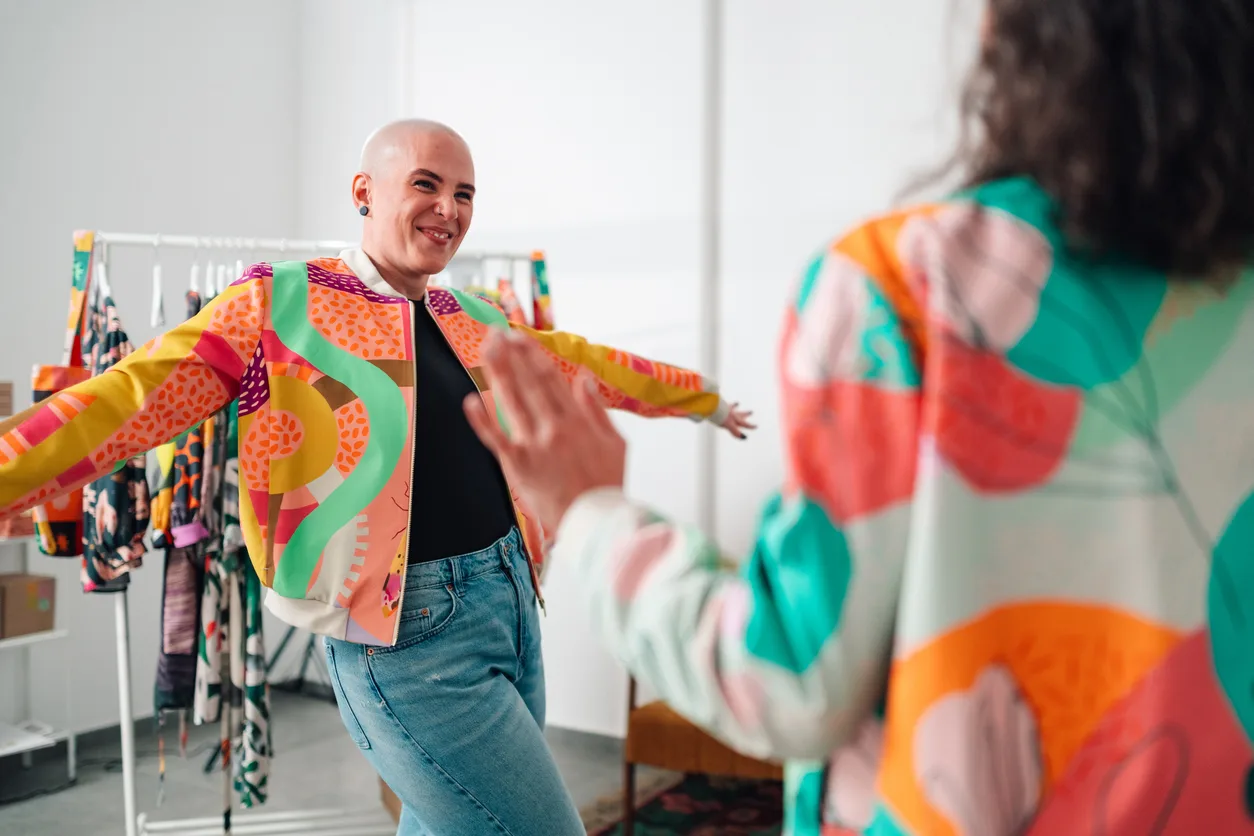
We set out to examine how gender-fluid products and styles, such as clothing lines, operate in the real world. Studies tell us that consumers want these products, and the general assumption is that they are balanced, meaning a 50-50 split between traditionally female and traditionally male styles. We wanted to know if that is actually true. What we found is that it is not. In our studies, which included 200,000 fashion products and over 100,000 baby names, we found that gender-fluid products and styles overwhelmingly originate in masculinity, even though they are most often adopted by women and nonbinary consumers.
What are the lessons in that for executives who are bringing products to market?
There is a lot that marketers can learn from this.Products that are sold as ‘for everyone’ are not neutral by default. A product designed to signal inclusion can ironically reinforce societal imbalances. Designers, brand leaders, and executives should understand which cultural signals are being elevated and whose status they reinforce before they bring products to market. These factors can influence everything from the language they use to describe their products to the products themselves.
You’ve mentioned that a book on baby naming and cultural change first sparked your interest in studying gender and symbolic consumption. How did that early inspiration translate into the data you ultimately used in the paper?
I’m quite a data-driven person, and when I first joined the PhD program in 2019, my advisor, [Columbia Business School Professor] Silvia Bellezza, who is my coauthor on this recent paper, showed me a book about how we can use names to understand cultural changes over time, societal changes, and even fashion changes. That idea stayed with me.
If you think about it, if you’re a parent and you are going to name your child, there are different objectives you may have. There is a tension between wanting a name that feels unique and one that allows the child to fit into society and thrive. What you choose certainly says something about you as the parent and your preferences and your tastes, but also about what you want your child to grow up with. Those types of decision criteria are highly applicable to my research. If you think about fashion, it’s symbolic consumption, a way to feel unique. But there’s also this other element to it. You kind of want to fit into society.
At what point did you decide to analyze baby name data collected by the Social Security Administration, and what made it feel like the right foundation for a project that was ultimately not about naming but about fashion?
I knew early on that, down the line in my PhD, I really wanted to work with the Social Security name data set, even though at that stage I didn’t have an idea how. What immediately stood out was that the name data spans from 1880 to today. It is vast, which makes it particularly rich for understanding cultural and societal change. That tension is exactly what I study in marketing: how people try to express something personal while also fitting into a broader social context. The name data gave us a way to observe that process unfolding over more than a century, which made it a natural and powerful foundation for studying how gendered associations evolve over time.
When did you land on the questions about gender fluidity in fashion that became your research topic?
That came later, in 2020, when I lived in New York City. I spent a lot of time out in Williamsburg, Brooklyn, and that’s when I noticed my male friends wearing dangly earrings and pearl necklaces, which, before that, I would have only seen worn by a woman. Then the pandemic began, and I returned to Germany, where I continued to observe similar cultural signals. I was locked down, spent time on TikTok, and saw all these male creators wearing very feminine jewelry. It wasn’t only creators—it was Justin Bieber and other celebrities, too. Timothée Chalamet. Bad Bunny. Pete Davidson. Harry Styles. That was the year when many fashion designers wanted to showcase a more fluid sense of fashion. A couple of years later, there was a big collection at the V&A museum in London on fashioning masculinities. I noticed there was really something happening with how people are dressing.
You’ve said you noticed men first — but your findings emphasize an asymmetry in the other direction, that gender fluid styles are in fact worn less by men than by women and non-binary individuals. How did you make sense of that?
If you think about it, women have been dressing across the gender binary for much longer, trying to assimilate with men by adapting their styles. It was only when men started doing it that the marketplace actually paid attention. It goes against the norms of masculinity, so it’s more noticeable. I wanted to understand why people are doing that. Why do they blur the lines between what is considered traditional masculinity and traditional femininity?
That's when I fell back on my name data set. It turns out that the name context is helpful in studying the evolution of gender norms. We show that parents are more likely to give their daughter a name that is traditionally associated with masculinity than vice versa. Parents want their daughters to thrive in a world that is still perceived to advantage men in one way or another.
What are you most eager to explore next?
Currently, I am passionate about aging and the impact marketers can have through whom they choose to represent in their communication strategies. Across industries, we find that portraying older models leads to more positive consumer reactions than portraying younger models, in part because it evokes peace of mind about one’s own aging process. Linking back to this angle on gender, we find that in the beauty industry, these portrayals are especially calming for women, who face strong societal pressure to appear youthful.