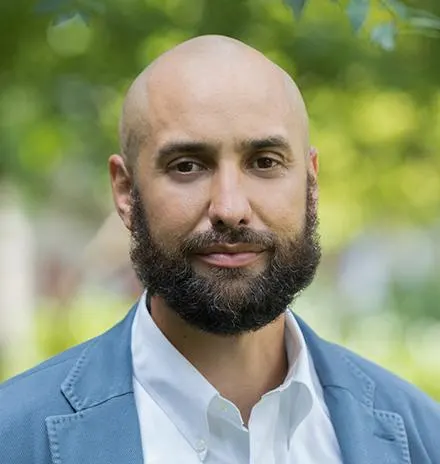

Editor’s note: Harvard Business School Assistant Professor James W. Riley led a three-year research program, the blackbox Lab at the HBS AI Institute, that studied how the technologies behind digital design, digital platforms and AI systems can intersect with race, culture, and business. We sat down with him to discuss what this research says about the cultural aspects of AI implementation. The research has been highlighted in a 2023 Harvard Business Review article titled Eliminating Algorithmic Bias Is Just the Beginning of Equitable AI; a 2025 working paper called Performance or Principle: Resistance to Artificial Intelligence in the U.S. Labor Market; and a 2025 white paper called State of the Market: An Industry Analysis of Tech-Enabled DEI Products. The interview has been edited for length, clarity, and style.
Are there lessons from your 2025 working paper that are helpful for business executives who are implementing AI?
We just wanted to establish a baseline to understand how open people are to AI augmentation and automation across various occupations, and it turns out they're pretty much okay with it in most cases, at least hypothetically. But there are some things that they really don't want to see outsourced to robots. And as you might assume, our working hypothesis was that those are things that really get closer to the heart: intimacy, family, spiritual beliefs. Things that you could say require a personal or human touch. For things that require that personal touch, they want it to be authentically human.
For example, customer service may be one of those things that people aren't particularly too bothered about being automated; they’re fine with talking to a sophisticated AI that's responsive and on point. But if you're making cultural products like fine wine , they don't necessarily want something made by robots if they can help it. It just hits differently because that's a cultural heritage thing. We're now living in a world where it's not always about cost and quantity; it's also about quality and how it resonates culturally with a given audience. So knowing where it’s safe or ‘cool’ to draw the line will require further research … to establish exactly where the red lines are.
How about lessons from your 2023 Eliminating Algorithmic Bias article that may be useful?
There are two sides to any market. Sometimes we only focus on the supply side, how to make that better, how to make it more efficient, how to make it scale and grow. And then there's the other [demand] side … where we need to know about the consumer and what they care about, what they value, and what they're after. We need to think about both sides when implementing AI … We need to consider how customers experience the results and whether it's seen as a betrayal or an enhancement from their perspective.
If more and more robots are going to be doing the work, we might also want to think about how that could disproportionately affect some demographics more than others. And while it's not up to the CEO to boil the ocean and solve all the world's problems, there are ways to integrate AI systems where you can be cognizant of this, and you can still be rational, and you can still actually make a profit. And so, by being informed about both at the same time, you're also not alienating and destabilizing the very audiences you depend on to buy your products.
Do these lessons for business leaders apply to underrepresented communities, or are they more general lessons?
In [the 2025 white paper], we examined the prospects of diversity and inclusion in improving business performance. An underlying assumption was that having people who have various lived experiences, and by bringing their unique perspectives to the table, not only as users but now as designers … will give you a unique advantage. And that thesis is still being tested …
If you're Jeff Bezos, how do you ensure that the AI you’re developing is servicing different communities in a way that’s resonant with their different cultural tastes and preferences but also doesn’t lead to inequitable outcomes?
I won’t presume to know what CEOs should do, especially one as successful as Bezos … [But] it might be worth hiring people with expertise in these areas and who care about how you are targeting diverse customers. Having multiple theories being tested … theories of value being tested … simultaneously, is probably worth the marginal cost. While you might have a design that works most of the time for most folks, that's great; that's your hammer. But to a hammer, everything's a nail. You might also want to have someone on your team who carries a different tool to take a look at the same problem, and perhaps provide you with a perspective you hadn't even considered.