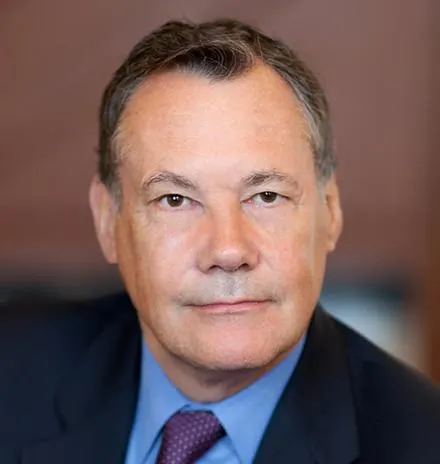

Editor’s Note: Many businesses are doing their part to support democracy, giving employees time off to vote, register voters or volunteer at the polls. That's not only good for business and the country, says Harvard Business School Professor Geoffrey Jones. It's part of what it means to be a "deeply responsible business," not coincidentally the title of his book. In a conversation with BiGS, the business historian talks about the challenges of exercising the right to vote in the U.S., how companies can help, and why being deeply responsible doesn't mean being unsuccessful. The interview has been edited for length, clarity and style.
Political parties and NGOs are already registering voters and getting them to the polls. Why should businesses get involved?
If I go back to my book [Deeply Responsible Business: A Global History of Values-Driven Leadership] about deeply responsible business, one of the three things [companies] should do is interact, with humility, with other stakeholders, including their employees. And facilitating their employees to take part in the democratic process, is, I think, a deeply responsible thing to do.
I think it's particularly important in the United States. I believe the United States is the only country in the world that has elections on Tuesdays … a working day. And so, American workers are under particular pressure not to exercise their rights. [Firms] are not responsible for the fact that the U.S. has elections on Tuesday, but we do. And I think then it becomes part of the responsibility to facilitate people being able to vote.
Is the responsibility particularly important now?
We're at a time of acute polarization on the one hand, and at the same time, of a lot of disillusionment and cynicism, both about business and about government. I think it's a pretty good time, really, because it would probably facilitate people voting who wouldn't have been able to go to vote … making them feel the process is actually meaningful. It’s what we want in an active democracy.
Are there risks for companies? Should they fear being targeted for getting involved in voting?
I think it would be a question of how it was executed. If it was rolled out exclusively in Democratic states — California, Massachusetts, New York — I think there would probably be an adverse reaction. But if it's rolled out nationally, with the right framing and the right language, I don't think the administration would object. We could [have] a coalition of businesses in different parts of the United States, thinking that this is just a good thing. I think that's absolutely essential. It should be companies based in a wide geography of blue and red states.
What's the business case for being ‘deeply responsible,’ particularly when it comes to democratic institutions?
The narrow business case is that firms with a good reputation for being responsible and ethical are finding it easier to recruit very good people. A considerable number of younger generation people in particular want to work for a company doing good in the world rather than making it worse. I talked to somebody, for example, whose company was becoming a B Corporation [a certification for firms that meet certain social, environmental and governance standards]. And he told me he was primarily motivated because it was easier to recruit the high-quality people his firm needed. [They] had a sense they were doing something good for society, rather than just causing problems. So I think that can be important. The more profound business case is that society at the moment is broadly dysfunctional. You could say that there's the obligation for businesses to try and do their part to make things work better again.
What does small-d democratic governance mean for businesses themselves?
Democratic governance and rule of law was always the strength of U.S. business. At the moment, both are clearly under some degree of threat. That's a business case. That's not a partisan case. That's the bottom line of what made American business so successful. … Doing your bit to keep the norms, I think, is pretty important and it's not a partisan issue.
What's the basic takeaway from your book?
It is perfectly possible to build a successful business and to be deeply responsible. The book has historical examples of people who've done that. Is it costless or straightforward? No. It's actually tough, because you're competing with people who aren’t responsible. Is it worth doing? Yes. Because our society and the environment are all heading in the wrong direction. And I think business leaders, as well as journalists and professors, should all do what they can with their respective talents to try to build a world that flourishes.
What is a good example of a deeply responsible business?
The nineteenth century British Quaker, George Cadbury, who created his country’s largest chocolate company. Why is he deeply responsible? Well, he really cared for his employees, paying them well and recognizing their right to join trade unions. He built a village to house them outside the squalid downtown slums of Birmingham, England. And instead of the familiar paternalist story, he actually gave away that village to a trust. It is still Britain's largest housing trust. He also believed he could use his status as the biggest chocolate company in Britain to lobby governments for policy changes, but he didn't lobby governments for his own corporate interests. He lobbied them directly for societal interests. He was extremely influential in the British getting an old-age pension system—and it had no benefit at all to his firm.
Can you tell us about an American business that is deeply responsible?
Edward Filene [the Boston department store founder] is also extremely interesting. As he grew his business in the late nineteenth century, he became obsessed with countering inequality. He initially tried simply to pay the highest wages and charge the lowest prices but over time he came to the view that the only way to counter inequality was to shift the ownership of property. So he tried to give away his department store to his employees, which was pretty remarkable. It didn't work, partly because of family squabbles, but his ambition was clear.
He also believed that business leaders have a responsibility beyond the firm, so he used his reputation and his money to boost the American credit union movement. He’s primarily responsible for the growth of credit unions in the interwar years, whose numbers rose from a few dozen to 3,600, with 750,000 members in 1935. In that year he became the first president of the Credit Union National Association. He was also very concerned about democracy and what he called propaganda, which we now call fake news. So shortly before his death, he set up and funded the Institute for Propaganda Analysis to try and counter fake news, including the antisemitism spreading in the United States and Europe. He maintained democracies could not work if people did not have access to truth.
What lessons do those examples provide for the current environment in the U.S.?
I think there’s a lot of cynicism at the moment, disillusionment, maybe. And if a business can actually be seen doing something that isn't partisan, which isn't in the firm’s particular interest, something to improve society, it could be a significant benefit.