BiGS Actionable Intelligence:
BOSTON — A research program focused on how digital design and artificial intelligence can impact historically marginalized communities beyond algorithmic bias yielded lessons on how business leaders can communicate in ways that connect culturally.
At Harvard Business School’s AI Institute (formerly the Digital Data Design Institute), the blackbox Lab explored how digital design, digital platforms, and AI systems can be leveraged by minority businesses to reach a broader constellation of users and consumers.
One major finding was that the cultural values and meanings surrounding AI tools and their use across industries and domains can be a powerful lever for building trust among consumers, which can affect technology adoption and consumption.
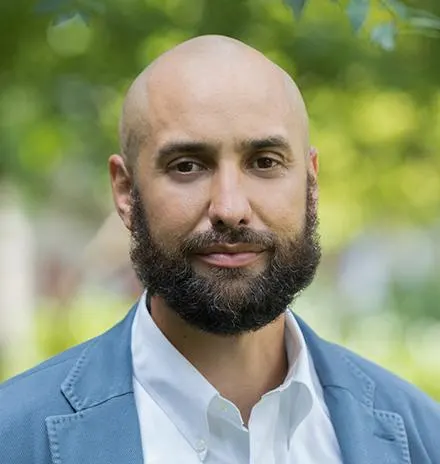
“You need to connect to audiences in ways that are culturally resonant with them, such that they see themselves in your business and your design choices,” said Assistant Professor James W. Riley, who led the blackbox Lab. “Not simply that they're being invited into some preexisting value system that they will need to fit into and don't particularly feel drawn to or attracted to.”
One example comes from an HBS teaching case the lab produced on the Atlanta-based banking platform startup Greenwood, founded by entrepreneurs Ryan Glover and Paul Judge to serve underbanked communities. The Greenwood platform serves Black and Latino consumers with a suite of financial products, such as checking accounts and loans, and the promise of a welcoming environment.
The company has attracted both attention and investment and has made several acquisitions. It reportedly has a community of more than 1 million people and passed 150,000 account holders in the summer of 2023. “This is more than banking — it’s a movement,” the company says on its website.
Riley said Greenwood resonates culturally with its target customers in several ways. First, it is named after the community in Tulsa, Oklahoma, once known as “Black Wall Street,” which was the location of a racial massacre in 1921 but persevered and today has seen a revival in cultural institutions, remote work, and tech incubation.
The company also appointed leaders to its board who are well known to its audience, such as civil rights leader Andrew J. Young, a confidant of Dr. Martin Luther King Jr. in the 1960s, and Atlanta-based hip hop artist and activist Michael Render.
Greenwood also meets customers where they are. It provides services via mobile devices, compensating for the lack of convenient brick-and-mortar banks in many marginalized neighborhoods, and communicates through the platforms and social media that its customers use. That type of awareness and accessibility builds trust among everyday users and consumers, Riley said, and that inclusion ultimately amounts to a market expansion strategy.
“Once you are able to meaningfully and purposefully access marginalized communities, then you can amass quite a sizable market segment,” he said. “You are looking at an inclusive growth strategy that ultimately leads to better services and higher margins.”
AI and cultural credibility
Similar lessons about cultural credibility can be drawn from a novel chatbot, ChatBlackGPT, one of the AI use cases highlighted at the Ethical Tech Showcase! co-hosted by the blackbox Lab last year at Harvard Business School. ChatBlackGPT is an artificial intelligence tool developed by tech developer and entrepreneur Erin Reddick on infrastructure from OpenAI (the company that released ChatGPT). Reddick says on the company website that the product, now in its beta phase, provides “insights from a Black perspective with cultural awareness and sensitivity.”
Riley cites ChatBlackGPT as an example of an inclusive application that can help businesses grow by reaching larger audiences in ways that resonate and represent their cultural sensibilities.
“If you don't have a GPT that is versed and trained on data in the African-American vernacular … and doesn’t correct for the dross of preexisting training data that outputs slop, you may actually have negative stereotypes and imagery of Black Americans that is going to be alienating, to say the least,” Riley said. “From a business perspective, you're going to be … missing out on an entire segment that might otherwise turn to your product and content.”
In contrast, ChatBlackGPT “will give more accurate, more culturally resonant and more appropriate responses to chat prompts,” Riley said.
Technologies like artificial intelligence are about more than efficiency, said Christina Jarymowycz, who was the lab manager at the blackbox Lab when it began its research program in 2022, and is now Assistant Director of Labs at the HBS AI Institute.
“[AI] is also about human perception: how technology influences people’s lives, work, relationships, creativity, and sense of trust,” she said. “That is particularly important in industries and domains that are understood as spaces of human feeling, judgment and creation.”
Riley understood this, bringing his depth of domain expertise in the creative industries and cultural markets to help further develop our understanding of the social and cultural factors that shape digital design, digital platforms, and AI systems in a world full of cultural differences.
“Resistance to AI is real, and the values and meanings around AI tools and platforms are constantly being drawn and redrawn,” Jarymowycz said. “That has repercussions not only for customers and sales, but also for brand, employee satisfaction, trust, and the cultural legitimacy of a company’s products and platforms.”
Riley’s vision and original proposal for the blackbox Lab set out to explore exactly these underlying factors. The Lab succeeded in delivering on its promise on a number of fronts.
“The lab was not only producing research,” Jarymowycz said. “It was helping build and amplify an intellectual community around Black entrepreneurship, digital transformation, and cultural production.”
Lab accomplishments
Though the blackbox Lab completed its three-year research cycle in July of 2025, it leaves a legacy of case studies, internal conference proceedings, working papers for journal submissions, and multiple large novel databases, all reflecting its original and ambitious research program. The Lab also had a keen interest in technologies and business models that aim to address the persistent wealth gap in the U.S., which is especially pronounced among Black communities and businesses.
Furthermore, the Lab supported an intellectual community, Jarymowycz said, creating a space for scholars whose work grapples with contemporary and historical understandings of the Black experience across professions, organizations, entrepreneurship and digital spaces. It also served as an academic platform to advance scholarship in this domain, as well as to highlight Black digital entrepreneurs and innovators in fields ranging from creative industries to healthcare access, financial inclusion, inclusive technology, and platform strategy and design.
The Lab conducted a seminar series that drew tenure-track faculty from other institutions to present their research; a series of workshops in partnership with Howard University that examined how data science and business strategies can be harnessed to produce more inclusive outcomes; and a scholarly conference that convened academic specialists from realms as diverse as ethnomusicology, behavioral economics, and cultural linguistics. The Lab’s convenings included the Ethical Tech Showcase!, which brought together researchers, entrepreneurs, cultural innovators, and philanthropic funds to learn from participants about the different ways technology is being developed to promote the participation and inclusion of people from marginalized groups.