Editor’s Note: The BiGS Roundtable in Nashville last year drew scores of leaders in business, government and academia together to explore emerging models for accelerating economic mobility. Among them was Cesar Gueikian, CEO of the guitar maker Gibson, a veteran entrepreneur and executive and a guitar player himself for more than thee decades. We caught up with him to discuss the iconic company, its decision to create an employee ownership program and the impact it has had on Gibson’s culture. The interview has been edited for length, clarity and style.
How did you become CEO of Gibson, the iconic guitar maker founded in 1894?
Gibson has been in music since the beginning of recorded music. Over the last couple of decades, the leaders of Gibson at the time made the decision to diversify into consumer audio, which is a very different business from manufacturing premium-brand guitars. The diversification strategy did not go well. As a result, the company couldn't refinance the debt that it took on to acquire those consumer audio businesses. In 2013, I started buying pieces of the Gibson debt with the original hypothesis that the company was not going to be able to pay that debt back. And in 2016, I reached out to the private equity firm KKR, which became majority owner and led the change of control that culminated with us taking over the business in 2018.
Why were you attracted to the business?
It's one of the most significant brands in music. I have a lot of relationships with artists, and everybody wanted to see Gibson succeed. And when you look at the actual business, it was never the actual core of Gibson that was in trouble. It was the other things that were dragging the company down. Gibson had the wrong capital structure because of bad decisions made in the past. And so I firmly believed that there was an upside case to take over the business, restructure it, sell the non-core asset and refocus Gibson on the core.
When you first stepped into a leadership role, what did you see on the factory floor that convinced you that the company needed a different approach?
I've seen first-hand our people's enthusiasm and knowledge. Our employees’ average tenure is probably one of the longest in the United States, maybe globally. I just had the privilege to celebrate the 50-year career of Kathy Kelly [an employee who has played many roles at Gibson]. Over the next couple of years, we are going to celebrate many people reaching 50 years at Gibson, like Kathy. We have a lot of knowledge at Gibson, and we need to tap into that. One of the first things I did when I hit the factory floor was really listen. During my first three months at Gibson, I wasn't in the office. I was in the factory.
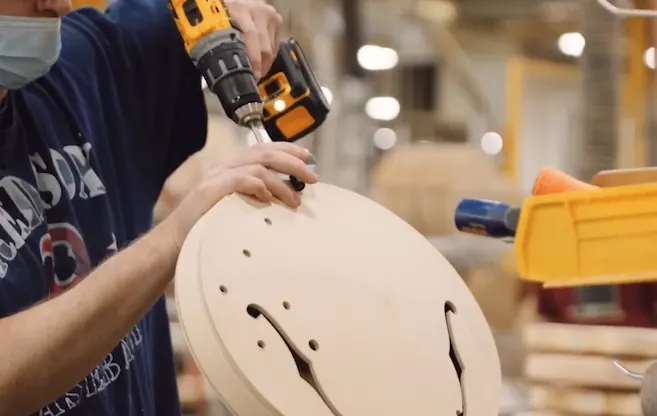
Every Friday morning, I go and help build a guitar. These visits give me an opportunity to learn from our people because it's very complicated to build a guitar. And even though I've helped with 10 guitars, I still really don't know how they do it. I needed help in every step. But every Friday, I learn a little more, and I learn it from them.
How has Share of Success, Gibson's shared ownership model, helped you connect employee knowledge to overall strategy?
We needed to turn the business around by getting rid of non-core assets and refocusing on our core. And that included a very significant capital investment from KKR, with a lot of pressure to generate returns on that investment. It was actually KKR that came up with the idea for this type of plan, where everybody in the company participates in value creation and reaps the benefits.
The biggest benefit of our plan is that it influences behavior. It aligns incentives and makes people behave differently. And it leads to a different type of two-way communication flow where employees not only accept our strategic priorities, leadership style, and our ideas but they also start to advocate for them. And that's when we get real leverage.
Explain Share of Success a bit more
The Share of Success program is a straight percentage of profits that we allocate to everybody in the company. Here's how it works: whenever the company intends to distribute profits to shareholders, it first passes through the filter of Share of Success. Every time a shareholder receives a payment, employees get their cut. We didn't structure the program as stock options, which could potentially lead to options being in the money or out of the money.
The first liquidity event happened in November 2021, and it was significant, which helped remove any lingering skepticism of the program. Before that dividend reached shareholders, it passed through that filter of the Share of Success, and everybody got their share. Once the company distributed this very tangible benefit to everybody, we had evidence the program was doing what it was supposed to do. So, it was a very important moment for us.
How has Share of Success impacted Gibson's overall culture?
When you look at the company from a shareholder' perspective, you start to ask: how much value are we generating? How are we influencing gross margin? And how is that affecting our bottom line? And there are many different key performance indicators we can use to track performance. Some of them are tangible, which is straight math with bottom-line figures like EBITDA and net income. And then there are intangibles such as employee engagement.
For example, I firmly believe that the Share of Success program has created a culture of A-players. We have now another level of scrutiny on the factory floor, because there's nothing more demoralizing for an A-player than to have to tolerate a C-player. We're creating a culture in which everybody wants to create value and nobody wants to work with C-players. So those types of employees self-select themselves out and we keep a culture of engaged people that are thinking about creating value. I know this is happening because I'm on the factory floor every Friday. I'm there building with them. And they tell me, they ask me questions, they want to know how we're doing beyond every quarter where I get to share information with them. So how do you value that kind of engagement? I don't know. But I know there's value.
How does an engaged workforce respond to uncertainty?
We've been around for 131 years. We've have had many moments of uncertainty. We've gone through two world wars. I always remind our people of that. This is a moment in time. Uncertainty is okay. We're going to be dealing with uncertainty. The question is: what do we do about it?
There are moments of growth and crisis. And perhaps my role is to make sure that we don't let a crisis go to waste. What are the things that we can control and what are the things we can't control? For example, I can control how much I communicate with our team. So, when I go to the factories every week, conduct monthly reviews, or host quarterly town halls, we communicate with our people, and we let them know what's going on. We are all facing these challenges. And so, they understand that we are focused on protecting our business, creating stability within Gibson, and investing in the things we can control to keep creating value. It all comes down to communication.
What kind of role should business play in helping workers achieve economic mobility?
It is the responsibility of businesses to create wealth, and create wealth for all the stakeholders, not just the shareholders. And those things go together. Creating value for shareholders cannot come at the expense of the rest of the stakeholders, particularly your people. When you allow your staff to participate in the creation of value, that will, over the long term, generate more value to the shareholders. People need to understand that. Those two things are connected.