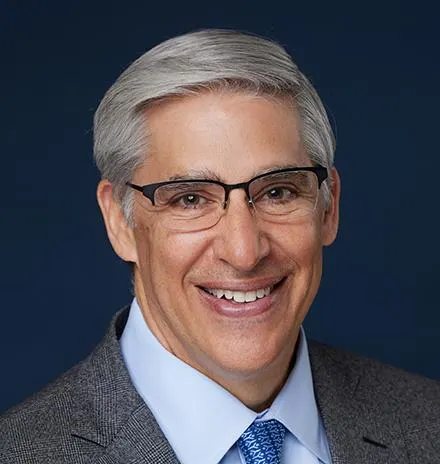

Gerald Chertavian is a senior lecturer at Harvard Business School, where he teaches a class on social entrepreneurship and systems change. A former technology entrepreneur and Wall Street banker, Chertavian obtained an MBA from Harvard before founding Year Up United, one of the nation’s largest and most effective youth workforce development programs. We talked to him about the value of a first job (including his), how American workers are trained and how to reduce the “opportunity gap.”
You had a change of career after getting involved in Big Brothers Big Sisters of America. Tell us about that.
I met my little brother David in 1987 when I was working on Wall Street. I spent every Saturday of my life with him for three years. That experience showed me what the opportunity divide looked like in practice. David had all of the talent, motivation, and desire to be successful, but his potential was being limited by his zip code, the bank balance of his Mother, the school system he attended and the color of his skin. This struck me as a tremendous waste of talent in a country where we have no one to waste. I vowed back then that someday I would start a program to try to close the opportunity divide and wrote my essays to get into HBS about this concept.
You saw what you described as an 'opportunity gap.' Please explain what you saw and what you thought the solution might be.
My experience at Big Brothers helped me to understand some of the drivers of the opportunity divide. It wasn't until I cofounded a technology company that I began to understand what a solution could look like. We were a fast-growing company and needed talent. I saw over the years that some of our best talent didn't always come from the usual places. In fact, one of our best employees didn't finish high school but was an amazing technical talent. That got me thinking about all the people we might be missing if we just rely on hiring from elite colleges. I could see there was a way to connect talent with opportunity, to close the divide.
You got your start in technology and banking. Tell us about your transition to Year Up United.
When we sold our technology company, it put me in the fortunate position to have financial flexibility. With the advice of my mentors and the support of my family, I decided that it was the right time to make good on those HBS admissions essays. I begin working on the business plan for Year Up United in March of 2000 and we moved from London to Boston that August to start the organization.
Tell us what Year Up United needed to do in order to be successful and how you carried that out.
Starting any organization, whether it's a for-profit or nonprofit requires a great deal of energy and many more things go wrong than right. However, I believed so strongly in the young adults that we would be serving that I didn't let any of those obstacles get in the way. Having said that, there was so much that I didn't know about the field and whether it was luck or judgement, I fortunately hired an amazing start-up team that brought lived experience and a deep understanding of education and youth development. It was a good lesson: hire people who bring diversity of thought and experience and empower them to lead.
There were three keys to our success: 1) We implemented a model of high support and high expectations, which is our fundamental operating principle. We have very high expectations for our students and hold them accountable, while at the same time providing a very high level of support; 2) We focused heavily on empowering our students to be career-ready professionals. They learned the A-B-Cs of the business world: attitude, behavior and communication skills, and then brought those to employers; and 3) We partnered deeply with employer partners, listened to them and then met their needs for entry-level professional talent. We were part of an employer's talent acquisition strategy not simply a CSR initiative.
This was good business and it could be scaled. Since that first class of 22 students, we have served 55,000 deserving, motivated young adults and empowered them to reach their potential. It has been a deeply meaningful journey, and I remain grateful to this day for the opportunity I was given to be of service to this mission.
There's a tendency to think of fast-food or similar jobs as less-than. Why do you argue that is misguided?
First jobs are often great stepping-stone jobs. They teach one skills that are used throughout any future professional career—learning to take direction, working in teams, time management. You've got to be punctual. You've got to show up. There is real dignity in work, without question. And I think the issue is not about, is this a good job or a bad job. It's an opportunity, and a bridge to accelerate your career over time. The first job gives you foundational skills for every industry. If you look at the habits of executives, the habits they learned at that first job, they didn't disappear when they moved into corporate roles.
Are retail and food service jobs for everyone starting out—or just those at the bottom of the economic ladder?
I think we have to be really careful. If we denigrate these jobs, we're effectively denigrating the people who work in these jobs, and that's not appropriate. If you come from an affluent background, that first job is going to build character. For low-income adults, it also builds economic stability. It builds hope. For a lot of young people, these are jobs that enable them to survive, and they represent the first rung of economic mobility.
What is the responsibility of employers in these kinds of jobs?
Employers have both an opportunity and a responsibility to ensure that these first jobs provide solid training, good management and upward mobility over time. That means the opportunity to ensure you're providing bridges from those first jobs into even more mobile career pathways.
McDonald's has a new campaign boasting that one in eight Americans has worked at one of the restaurants at some point in their lives. How do they provide opportunity to those workers?
I would argue that McDonald's is one of the largest educators of young people in America. They're teaching work habits, English literacy, financial fluency. The jobs probably pay $12 to $20 an hour, depending on your city, but they have pretty good benefits, helping you with your GED or other education. The challenge would be if, five to 10 years later, you're still in that job. I think that's a missed opportunity to help someone build a path to a higher-paying job.
What role do companies have in educating Americans?
Think about how much time we spend talking about education reform. We don't spend a lot of time talking about first job reform. We need to hold up examples of companies that are creating first jobs which build skills and provide opportunity for career and economic mobility. There are backlogs of thousands and thousands of people wanting to learn English in the state where I live, Massachusetts. And McDonald's is teaching English, what many of our citizens need. It's easy to throw stones [at fast food and retail jobs]. It's more interesting and thoughtful to think about how these jobs become a steppingstone to economic mobility.
What was your first job?
My first job, at age 14, was bussing tables at a seaside restaurant. I learned how to be on time, to work within a team, and to keep a smile on my face even though the work was pretty messy! Doing a job well, no matter what it is, deserves respect.