BIGS Actionable Intelligence:
When a machine broke down at manufacturer Charter Next Generation (CNG)’s plant in Milton, Wisconsin, due to a broken part, factory employee Damon Pope had an idea.
He knew that buying a replacement would cost about $2,210, and would mean a lengthy wait. So, drawing on his passion for 3D printing, he pitched management on buying 3D printers and creating the part. Management said yes. CNG bought two 3D printers and Pope printed the part for $1.76 in just a few hours.
So it goes at CNG, where Kathy Bolhous, Chairman and CEO since 2010, thrives on doing things differently. Just months earlier, in November 2023, she had set an ambitious “Moonshot” goal to achieve an additional $100 million in incremental earnings, or 25%, within three years, in addition to any revenue growth. Rather than slashing costs to reach her goal, Bolhous focused on a new concept—employee ownership.
“Shared ownership is the ability to award every employee equity,” Bolhous told The BiGS Fix. “The way it works at CNG is that every employee becomes an owner from day one. No matter your position or role, you’re awarded equity shares when you join the company.”
Bolhous was introduced to the idea by KKR, an investment firm that acquired CNG alongside private equity firm Leonard Green & Partners (LGP) in 2021. KKR has implemented the employee ownership model at more than 50 companies in its portfolio since 2011 and is a founding member of Ownership Works™, a nonprofit that supports the shared ownership movement.
Bolhous believes the new structure will boost creativity, encourage problem-solving and ultimately improve profits, and evidence mounts that it’s working. Turnover rates fell, while profit and examples of innovation rose. For example, within three months, Pope’s 3D printing idea achieved about $128,000 in savings by printing parts throughout the facility.
“The printers paid for themselves in 15 minutes,” he said in a Harvard Business School case study. “I’ve worked 18 different jobs. This is the first one where you can come with an idea and they’re willing to invest to make it happen.”
Idea: When employees receive equity, ‘everybody wins’
Currently, more than 6,300 U.S. companies that employ more than 2.5 million people practice some form of employee ownership, according to Certified EO, an organization that certifies employee-owned businesses.
Ethan Rouen, a Harvard Business School professor who studies employee ownership and its use by private equity, and co-author of the CNG case study, said the current programs generate positive results at many companies.
“A private equity firm comes in, they buy a company, they give employees a stake such that when the PE firm sells, the employees will share in the wealth of that sale,” Rouen told The BiGS Fix.
For example, as part of the deal with KKR and LGP, employees at CNG were given a stake equal to a third of their salary in equity shares. This is a free and incremental benefit. It does not supplant any wages. Under this scenario, an employee earning $60,000 a year receives an additional $20,000 in equity. But it didn’t end there. Over time, the employee’s equity stake can grow with the business, perhaps to a year’s salary or more, giving employees the opportunity to build wealth.
The idea? Let everyone make money on the deal and give employees a financial incentive to make even more money as the company grows, Bolhous said.
“You make the pie bigger,” Bolhous said. “Everybody wins.”
A culture of ownership
Headquartered in Chicago with operations at 17 U.S. locations, CNG produces specialty films and material science solutions for essential food, consumer goods, personal care items, and safe medical supplies. The company’s solutions also enhance a variety of other goods, such as roofing, flooring, and car seats.
Bolhous, who was an executive at other manufacturing companies before taking the helm of CNG, told The BiGS Fix that she focused on creating a culture where employees feel valued and connected to the company and its purpose. So, when she had a chance to introduce the ownership model when KKR and LGP bought the company, she embraced the idea.
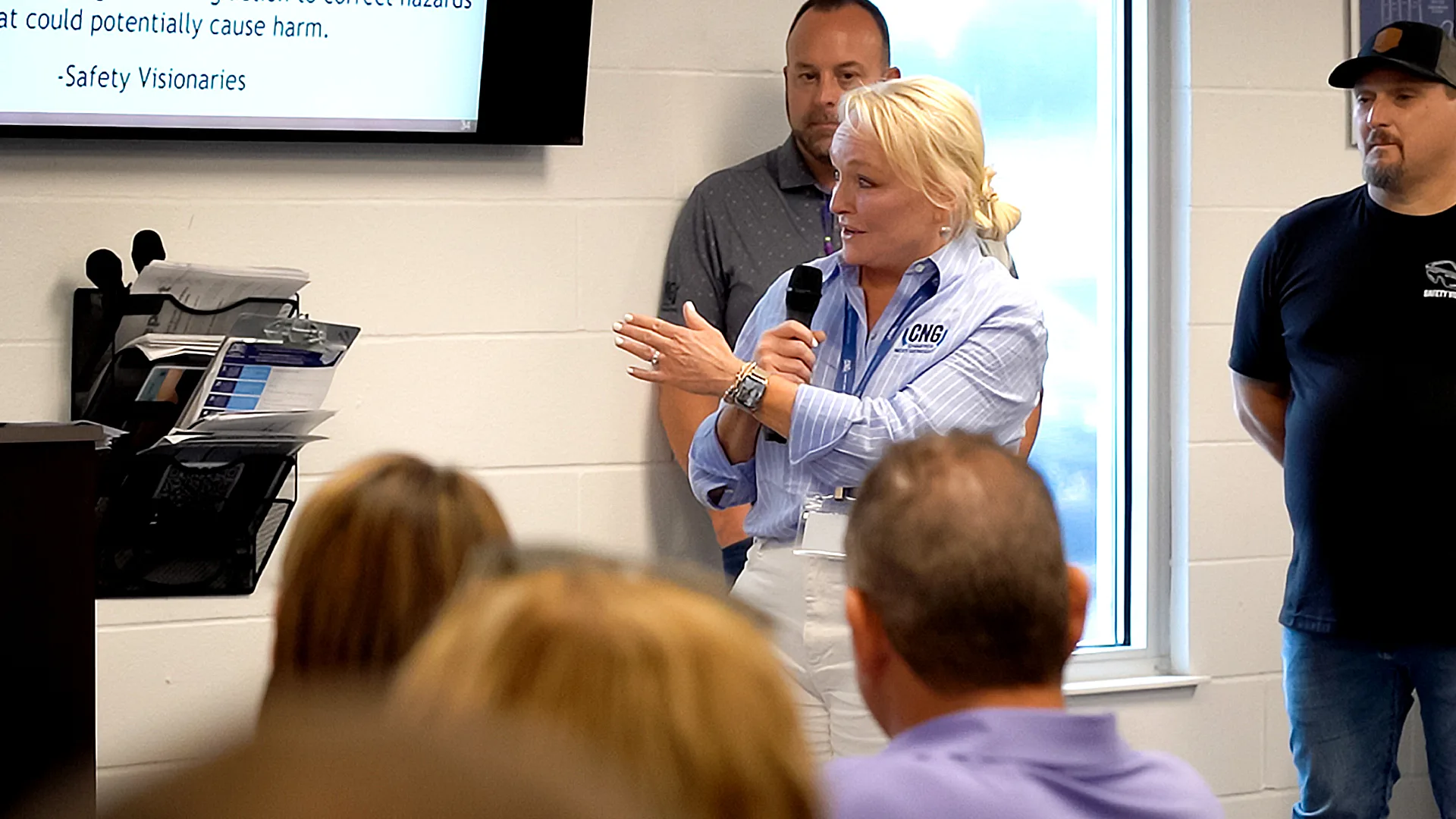
It wasn’t always a smooth transition. In the beginning, many employees didn’t understand the ownership model. Equity isn’t as tangible as a bonus. So, it involved a lot of different components, including lots of communication and having company-wide ownership meetings, plant meetings and “ownership boards” on factory floors to help employees see the impact their ideas were having on the company’s bottom line—and on their own stake in the company.
Bolhous also appointed a senior staff member as the internal “Moonshot champion,” as Rouen described him, tasked with securing buy-in for the initiative from top management on down, then collecting “Moonshot ideas” and prioritizing which ones to implement.
As employees began to understand how it would work, they inundated managers with suggestions, prompting the managers to bring in IT to digitize the suggestion process.
“We have had hundreds of ideas,” Steph Walker, a production manager at the Milton plant, told The BiGS Fix.
When people saw their ideas were taken seriously and that they were producing results, it reinvigorated the workforce. “That’s when people – or as we call ourselves, employee owners – start to get excited,” Walker said. “You’ve built this trust.”
Highlighting employee action
Aside from the 3D printers, other cost-saving ideas included optimizing equipment changeovers to reduce downtime and identifying ways to recycle scrap materials to limit waste and turn them into new products to sell.
In addition to sharing the results with employees, CNG also began highlighting employees who produced the ideas, further building an ownership mindset.
“The goal is to create the kind of culture of engagement where you're engaging the hearts and minds of employees to really want to deliver on the value,” Bolhous said.
Rouen says that happens when companies give employees agency over decisions that would traditionally be made by management, such as a capital improvement project or where the company’s charitable dollars are spent. “They give them say over a portion of the capital expenditures,” Rouen said.
For example, at CHI Overhead Doors, one of KKR’s most successful implementations of employee ownership, workers were given $1 million and allowed to decide how to invest it, Rouen said. They used that money to put in air conditioning, new break rooms and a health clinic. Executives hold regular meetings with employees to help them understand company growth and what their stake could be worth as a result. They also brought in financial advisors and tax consultants to help employees understand how to develop their own wealth.
The goal is a more responsive company and a more engaged workforce that combine to grow earnings. In some cases, it has delivered substantial results. KKR sold CHI in 2022 for 10 times the equity it invested and gave $360 million to employees. Workers got payouts of anywhere from $20,000 to $800,000.
CEO: ‘My confidence is high’
CNG needs a few more years to determine whether the Moonshot plan will be successful. But Bolhous said CNG has identified $40 million of the $100 million they’ve set out to gain—and she believes they’ll make it.
“Given what I see in terms of our employee engagement, our reduction in turnover, employees wanting to show up with their creativity to make the company profitable, my confidence is high that we'll be able to achieve it,” Bolhous said.
As Walker said, “It's something that people are really passionate about, and it's hard to describe. You know what you're doing matters. It matters to you and for me. It matters to the 100 people who work for me.”
Rouen said that successful employee ownership programs require leaders who, like Bolhous, have empathy for employees, a sense of responsibility for their well-being, and a belief that they can make a difference.
“She realizes that her work is for a lot more than just herself,” Rouen said. “She believes that she has the ability and the obligation to make [employees’] lives better.”
Bolhous finds helping employees share in the ownership of the company personally rewarding.
“Knowing that I, as the leader of this company, have the opportunity to enhance the lives of our very own employees is very rewarding,” Bolhous said. “It's a model that truly is a win-win.”