BiGS Actionable Intelligence:
Editor's Note: Earlier this year, The Ownership Project at the Institute for Business in Global Society convened a Worker Ownership Conference at Harvard Business School. A 28-page report from the conference, The Possibilities of Worker Ownership, is now available. It features takeaways from the event; information on financing, structure and governance; and how ownership influences employees, companies and communities. Download a copy now.
BOSTON — There are many reasons that conversations about employee ownership are increasing in boardrooms and classrooms around the United States.
Those discussions often start with America’s severe wealth inequality. In the third quarter of last year, the top 10% of the country’s richest households held roughly 67% of total household wealth, according to a study by the U.S. Federal Reserve Bank of St. Louis. Meanwhile, the bottom 50% held just 2.4%. The so-called “silver tsunami,” a wave of retiring baby boomers, many of whom own small businesses, could make matters even worse.
But never far away is a parallel conversation about employee ownership that focuses on incentivizing workers and increasing company performance. For example, Endeavor Fire Protection implemented employee ownership as it expanded to cover 14 states and doubled revenues in a two-year period. “Employee ownership creates a collective identity that provides value, respect, and belonging to a cohort of people to accomplish a greater goal,” said CEO Robert Lane. “It is a remarkable tool.”
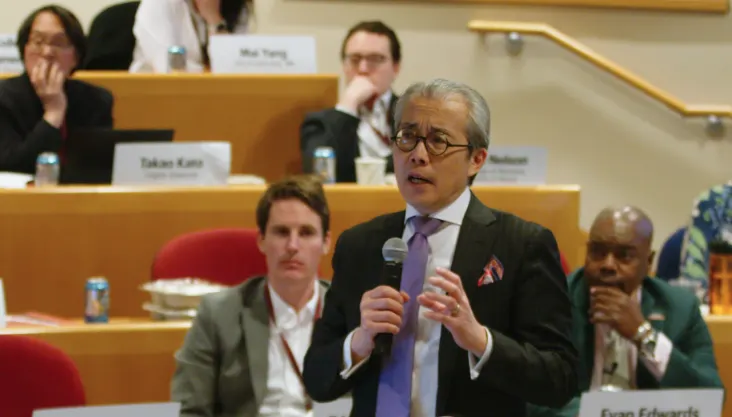
Those conversations fused at the Worker Ownership Conference sponsored by the Harvard Business School Institute for Business in Global Society (BiGS) in May, which gathered scholars, business owners, investors, government leaders and other stakeholders to discuss the benefits, challenges and lessons surrounding employee ownership. The conference was hosted by The Ownership Project, which was founded by BiGS in 2024 to expand the theoretical, empirical, and practical study of ownership.
“The structure of ownership is foundational for the economy, but neither scholars nor policymakers give sufficient attention to its design and application,” said Tony Guidotti, senior researcher for The Ownership Project. “The goal of this conference was not only to understand how worker ownership affects business objectives, but also to explore how it helps businesses and communities address pressing societal challenges and support human values.”
What is employee ownership?
Employee ownership can take many forms, each sharing a different mixture of financial benefit and managerial control to workers.
It can be an employee stock ownership plan (ESOP), where employees are given an equity stake in the business that allows them to directly share in the company’s growth and profitability through the allocation of dividends in an individual retirement account; an employee ownership trust (EOT), where employees are beneficiaries of a trust that owns the company and operates it for the good of employees; an employee stock option plan (ESO), where employees are gifted or can buy shares in the company at a specific price and time; or a cooperative (co-op), where employees fully own and democratically manage the company.
The idea of ownership isn’t to replace the traditional 401(k) retirement plan but rather to be a supplement, a way for employees to directly share in the ownership of the company and improve its functioning by aligning incentives and better integrating frontline employee expertise. Worker ownership is also an important way retiring owners can plan for business succession; by selling the business to their employees they ensure the company remains part of the community and that the value the company creates can go to the employees who helped build it.
That ownership can be a game-changer for employee morale, motivating them to use their skills and creativity to improve productivity, competitiveness, revenue and growth. When employees are part owners, they’re not just generating profits for the company. They are sharing in those profits.
Ownership is a path for many workers to build real wealth, which can have an impact on the lives of the workers and their families for generations. It can also influence society, lowering dependence on government assistance programs and other forms of aid.
“The fixed wage system has collapsed for the middle class,” said Joseph Blasi, a professor at Rutgers University and director of the Institute for the Study of Employee Ownership and Profit Sharing. “Research confirms that the families who are getting wealthy are getting wealthy because they have access to capital ownership, to capital income, to a percent of business profits, to a percent of business ownership, to dividends, to interest, to ownership of bonds. So, what we need to do is figure out a way to expand those things.”
Project Equity, an organization that helps companies transition to employee ownership, released a study last year that examined 10 companies that made the switch. On average, workers at these companies made 20% more than they did before the transition, and in some cases the numbers went even higher. For example, Adams & Chittenden Scientific Glass, which manufactures laboratory glassware in California, raised median wages 45% between 2019 and 2024, the study said.
A bipartisan issue
One of the themes that came up repeatedly during the conference is that employee ownership may be appealing to both Republicans and Democrats, making it a rare example of bipartisan agreement in the U.S. policymaking arena.
“Republicans view this as worker self-reliance, workers being less dependent upon government,” said Christopher Mackin, founder of the advisory firm Ownership Associates. “They like worker capitalism. [Democratic Senator] Bernie Sanders thinks it's democratic socialism. I don't care what you call it. It is a single strength of this idea that you can come at it from different ideological and historical traditions.”
Sabina Matos, the lieutenant governor of Rhode Island and a Democrat who attended the conference, said employee ownership can raise incomes and secure retirement in a way that has broad impact—and broad appeal.
“Normally we see one party as more pro-business and the other as more pro-community … those are the criticisms that you normally hear,” she said. “But when we are looking at employee ownership, we're putting both together. We're putting business and people together, and ensuring that people understand business is not a bad thing.”
Increasing the number who benefit from profitable companies is an idea that may resonate in both parties, she said. “That's the ingredient that makes it possible that we get bipartisan support.”
The ‘silver tsunami’
Employee ownership can also be an essential tool for addressing the “silver tsunami,” the wave of aging baby boomers at or nearing retirement. About half (51%) of U.S. businesses are owned by baby boomers, according to the Exit Planning Institute. In addition, more than three quarters (77%) of baby boomers would like to exit their businesses in the next decade, according to the Institute’s 2023 National State of Owner Readiness Report. Employee ownership can represent an exit strategy.
Many owners don’t realize the harsh reality of trying to sell a business: only about 20% to 30% of businesses that go to market actually sell. For the rest, owners have to stay on or close the business. And when a business closes, it’s not just a legacy that goes with it — it’s also the wealth and the jobs that it created.
Employee ownership can put that business in the hands of workers who are already helping the company run, who care about the business and have a vested interest in its future. The problem is that many business owners don’t know employee ownership is an option.
“Many of our clients worked with trusted advisors and have had those relationships for decades,” said Courtney Funk, an associate at Butcher Joseph & Co., a middle market investment bank that specializes in employee stock ownership plans and works with a lot of family-owned businesses. “When it comes time to sell their businesses, those financial advisors haven't heard of an ESOP or aren't aware of what ESOPs are, and so they're not recommending that as a potential transaction for the founder.”
The other problem, she explained, is access to capital to close these deals. Typically, a company will take on debt to buy out the founder and there aren’t a lot of lenders who specialize in employee ownership or understand how it works. Indeed, there are many different models, including hybrids. For example, a public company can also be partly owned by an ESOP.
The private-equity firm KKR, which has included broad-based employee ownership options in more than 60 deals across various industries, uses a model in which a share of the proceeds is reserved for employees when the private equity firm sells the company.
Even when companies do decide to embrace employee ownership, there is a hurdle: getting employees to understand it. Offering an ownership stake that may not enrich employees for five years or more is a lot harder to explain than, say, a bonus that workers can spend immediately. It also may not be intuitive for workers that their actions can directly affect the success of the company and thus the economic benefit they receive. There’s a need to educate workers to think like owners, and to understand both the corporate and personal finances that surround these deals.
Anne Arlinghaus, a partner at KKR, said it comes down to trust. “The key element of really unlocking value in these programs for the workforce is to create an environment where there's real trust between what your C-suite is saying and what the front-line worker believes and feels empowered to do,” she said. “We have started to see a correlation between leaders who have a high degree of empathy and their ability to really create that trust.”
Despite the challenges, Matos said employee ownership represents a new pathway to economic success and a new way to build community wealth.
“I believe employee ownership can change our society in a very impactful way,” she said. “When I look at employee ownership, what I see is the potential to make capitalism work for more people.”