BiGS Actionable Intelligence
SÃO PAULO — When Fulvio Pagani began managing the Argentina-based confection company that his grandfather founded 70 years earlier, his top priority was expanding the company’s reach to more than 120 countries.
Yet even as he lifted growth and profits for Grupo Arcor, which today employs more than 20,000 people in 45 countries, Pagani never forgot the philosophy his grandfather lived by — unless people have the means to buy what you sell, even the candy business will sour, he told The BiGS Fix.
“It’s in my genes,” Pagani said of his conviction that addressing inequality is good for business. “No company can keep on growing and do it in the future without having that social role. This is something that my grandfather started, and it was never a question. This is how we do business.”
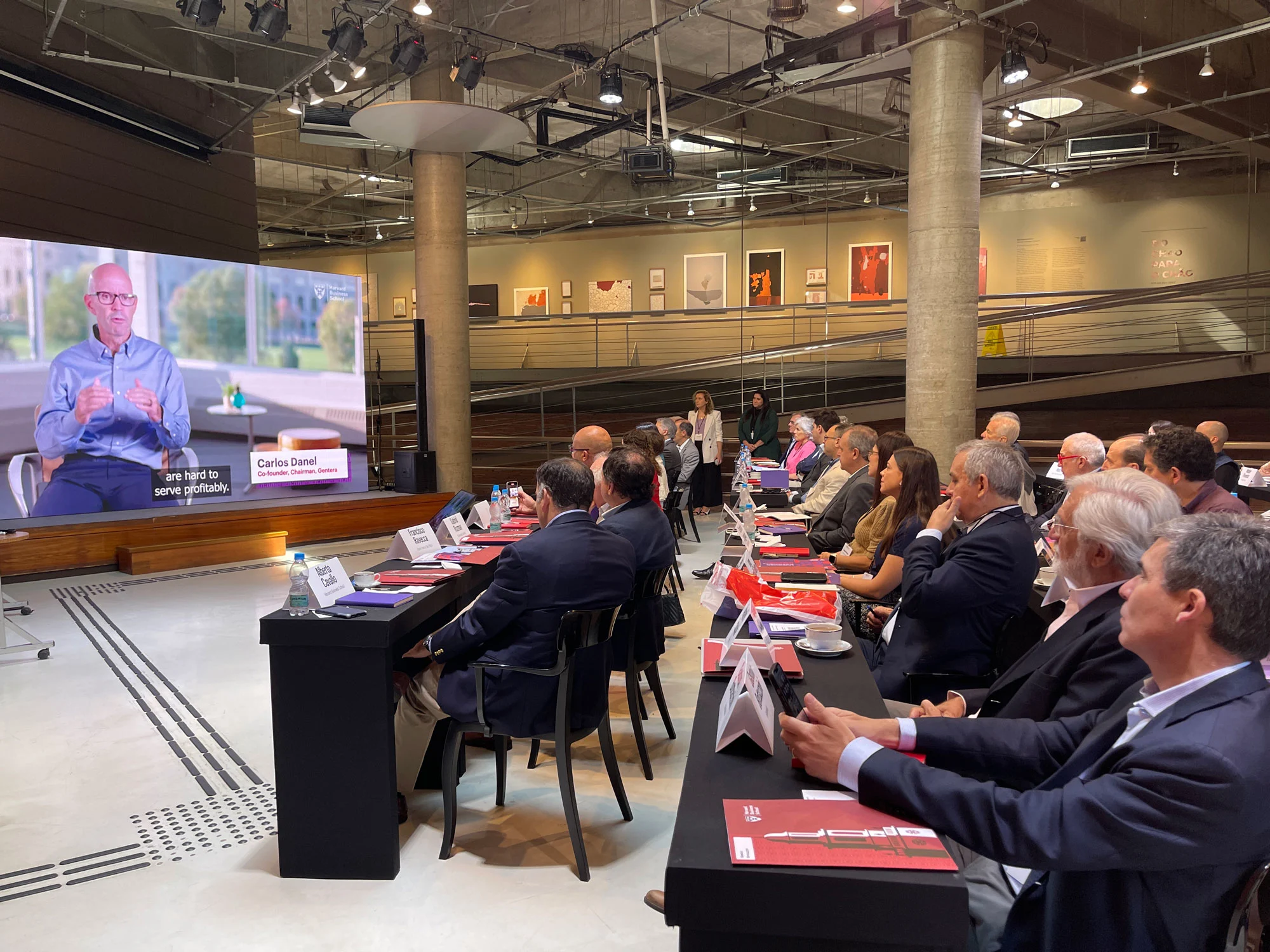
Pagani was among more than 60 corporate and nonprofit leaders who gathered in São Paulo, Brazil, at a roundtable convened by Harvard Business School’s Institute for Business in Global Society (BiGS) in November to delve into this complex issue.
Based on BiGS’ polls of attendees, the leaders agree that private enterprise can play a role in addressing societal issues as they generate profits and jobs. In one survey, for instance, 73% of attendees ranked economic inequality as the most or second-most important problem facing Latin America, compared with growth, inflation, and populism. Furthermore, 62% said they believed that business leaders have “significant” or “full” responsibility for addressing economic inequality.
Conference attendees came from Argentina, Bolivia, Brazil, Chile, Colombia, Mexico, the United Kingdom, the United States, and Uruguay. Facilitated by HBS faculty, the conference was marked by frank, concrete discussions on the private sector’s role in driving economic mobility — and the progress that enterprises have made thus far in addressing the wealth disparities that continue to worsen political and economic instability across the region.
The gathering, the first international roundtable hosted by BiGS, furthered the institute’s ambitious goal to fuel businesses solutions to some of society’s greatest challenges.
Persistent income inequality undermines socioeconomic progress
There are immense obstacles to closing the wage gap among Latin America’s 600 million people. The poorest 50% of the population earns just 10% of total income, while the wealthiest 10% earns 55%, according to the World Bank. Measured by income distribution, 16 of the 30 most unequal countries in the world are in Latin America. And inequality extends beyond income. Participation of women in the labor force, for example, is about 25 percentage points lower than that of men. While most children of the wealthy graduate from college, only one in ten children of non-college-educated parents obtain a college degree by age 25.
Persistent income inequality in the region, which encompasses South America, Central America, Mexico, and the Caribbean, has undermined socioeconomic progress for decades and resulted in social unrest, which aggravates political and economic instability. During most of the last two decades, solid economic growth rates helped improve social indicators. However, gains have stagnated since 2015, when growth faltered with the end of the commodity boom. The COVID-19 pandemic worsened conditions for the poorest segments of the population.
“In Latin America, towering skyscrapers and vast fertile farmlands are clear expressions of the critical role business has played, but the sprawling urban slums and rural indigence also reflect the human potential that is wasted,” Michael Chu, senior lecturer of business administration at HBS and originally from Uruguay, told attendees.
Continuous dialogue can fuel new ideas and action plans
“It is our aspiration,” Chu said, “that this roundtable may be the beginning of a continuous dialogue between all of us to find the new ideas and action plans that will harness the power of private enterprise to unlock this potential.”
Over two days of lively discussions, the business leaders rose to the challenge. They discussed, and at times disputed, the proposition that prioritizing doing good can be good business. They commiserated about the difficulties of working with governments, some plagued by corruption and mismanagement. Occasionally, they despaired over the immensity of the problems plaguing the region and the world.
But on these key points, attendees agreed:
Building new business models to serve the unmet needs of low-income communities can generate profitable solutions to address inequality.
Deploying capital to support businesses serving low-income communities can have an economic multiplier effect that creates a flywheel to positive economic growth for the entire community.
Investing in social programs for a firm’s workforce, such as education, can have significant long-run returns.
Building better futures: Home improvement company transforms dwellings and families
“It's time for businesses to understand that their role is to generate development, not only economic, but also social and environmental, on our planet,” said Brazilian entrepreneur Fernando Assad, who founded Programa Vivenda, a for-profit company that provides affordable home improvement kits to people living in the country’s vast slums. About 40 million Brazilians live in houses that pose health risks. (link to Assad video)
Assad started his business seven years ago. With more than $30 million raised from private investors and a partnership with furniture giant IKEA, he scaled up, creating a tech platform that connects thousands of slum dwellers to resources, credit, technical assistance, and construction materials that they can use to transform their dwellings with necessities such as bathrooms and running water.
“Every time I ask a client, ‘So what's your life now? What was the impact of your new bathroom?’ They always say, ‘I stopped fighting with my husband. My kid is studying more…,’ ” Assad told The BiGS Fix. “The point is, when we renovate an inadequate house, it's kind of a spark of development for all other dimensions of their lives, because the house is the … basis of development. So, this is the beauty of this work. You're not only improving the space, but you are improving the whole dynamic of life inside.”
While Assad’s business takes aim at one measure of inequality—inadequate housing—some enterprises’ primary raison d’être is making profits from addressing the wage gap conundrum, which is considerably thornier.
For profit and community: Deploying capital to spur inclusive economic growth
Almado, an impact investment firm in Argentina, is the creation of Alejandro Preusche, a former senior partner of the global management consulting firm McKinsey & Company.
In 2006, Preusche began developing businesses in Argentina and Paraguay with the express purpose of reducing poverty: organic waste recycling ventures, agricultural ventures, and affordable housing projects.
His investments in a poor region bore some unexpected fruit. Preusche bought farmland in a poor region in Paraguay at a low cost. When he invested in improving the land, the community, and its infrastructure, thousands of lives were improved significantly. In addition, the land value rose as other investors were attracted to the region.
“That was an eye-opener,” Preusche said. “Pay attention to the needs of the poor, and you’ll have a better business.”
Investment in worker education yields good returns
Falabella S.A., based in Santiago, Chile, started with one tailoring store in 1889 and now encompasses 588 shopping malls in seven countries, financial service operations, banks, and an e-commerce website that serve 38 million customers a year.
In recent years, Falabella made some significant corporate efforts to address inequality then-CEO Gaston Bottazzini said during the roundtable. It established financial education and technical advancement classes for its employees, a volunteer operation to offer skills training to prison inmates, and a partnership with nonprofits to offer job skills programs in communities.
“If you take the perspective that what you are building is long-term value rather than short-term economic results, then you're building a lot more customer loyalty over time,” Bottazzini said. “...I think it's very good for business.”
However, Bottazzini cautioned that while Falabella can help individuals, it can’t provide help at the scale necessary to make a dent in a vast societal problem. Only governments can undertake that sort of transformative change, he said.
Enrique Tellez, cofounder of a commercial real estate developer in Mexico City, knew that many of his construction staff had never finished primary school. So, he established private pop-up schools on the construction sites where employees can attend part-time during work hours. Run by a private educational partner, the schools provide primary, middle, and high school classes.
Hundreds of workers of Tellez’s company Desarrolladora del Parque have graduated from the programs, he said. Some have earned college degrees. Juan Martinez, raised by a single mother in a tiny mountain town who started working for Tellez when he was 19, earned a degree in engineering and now works as a supervisor for the developer.
“I'm a deep believer in education,” Tellez said. “So, if you were to ask me what the business rule should be, obviously we are set to create a profit … But within our means, we have to invest in our community.”
Grupo Arcor’s Pagani, whose sweets business helps fund university programs to train local workers near its plants, encouraged business leaders at the BiGS roundtable to leave their offices and see the needs in their own communities. That is the lesson, he said, his grandfather taught him.
“Go out there, see reality, see how people are living and try to understand what everyday life is for them,” Pagani said. “And once you see that, what you're going to say is, ‘I need to make a change, I need to be a part of this.’”