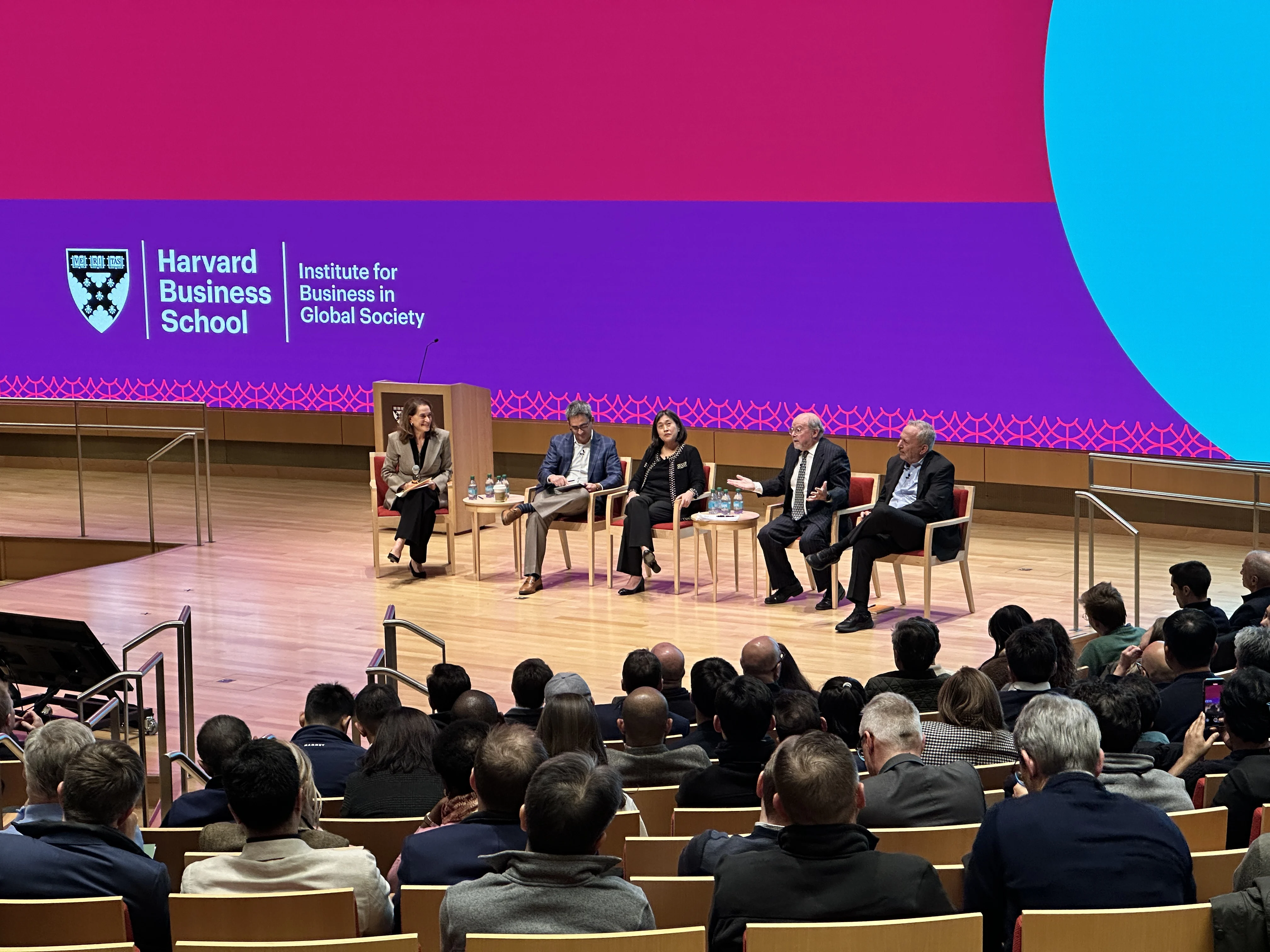
BOSTON — Is free trade the way to peace and economic prosperity? Or should the U.S. government impose tariffs to protect American industries and force foreign countries into buying more American products?
That question has become a kitchen-table issue for Americans, who are absorbing the impact of President Donald Trump's sweeping tariff policy. It was also the subject of a detailed — sometimes testy — debate among four high-level experts hosted by Harvard Business School's Institute for Business in Global Society Wednesday.
The latest BiGS Debate pitted conservative economist and writer Oren Cass and former U.S. trade Representative Katharine Tai, both of whom support targeted tariffs, against an equally heavyweight team of Lawrence Summers, former Treasury Secretary and president of Harvard University, and Robert Lawrence, professor of international trade at the Harvard Kennedy School of Government. Debora Spar, a professor and senior associate dean at Harvard Business School, moderated.
None of the debaters endorsed Trump's policy, which includes heavy tariffs on American allies. And all professed a concern for American workers struggling with a changing labor market and inflation. But they had different ideas of how to achieve that goal.
“We do need to make strategic use of tariffs,” Cass said. “I would like to see tariffs as low as possible with our allies, who are, in fact, interested in the balance of trade.” If, for example, China decided to manipulate its production and exports to try to dominate the American auto industry, Cass said, “the U.S. policy cannot be … free trade no matter what other countries do.”
‘With a pitchfork’
Lawrence argued that tariffs are a blunt economic instrument that don't serve their oft-stated purpose. Revenues can be raised with a simple sales tax, he said, and the government can subsidize production to create more American jobs. But tariffs, he said, are an “inefficient instrument” for employment or U.S. government revenues.
“It's like shooting at a target not with an arrow, but with a pitchfork,” Lawrence said. “You always create collateral damage.”
The debate came on a day when the United States Supreme Court heard a challenge to Trump's tariffs, a central tenet of the president's economic policy. The justices, in their questioning, signaled sympathy for the argument that the tariffs are an illegal use of executive power. A ruling to undo the tariffs could have extensive economic and political implications.
Summers noted that the group was debating in the aftermath of elections this week in which the cost of living fueled victories for candidates in New York, New Jersey and Virginia.
"Last night's election showed what should have bene obvious for a very long time: the American people care vastly about affordability,” Summers said. “Tariffs are sales taxes. They reduce affordability.”
Value to consumers
Tai noted that people need jobs to buy things — and without good jobs, having lower-cost goods does not make for a strong economy.
“It has been all about the value of these policies to the people in our economy as consumers," and not as workers, said Tai, who promoted a "worker-centered" trade policy when she served as trade representative in the Biden administration.
Cass added that the goal was not to sell more things to foreign markets, but “to return investment to United States, building in the United States. We want to be producing things here. We want to be serving our market.”
Summers contended that protecting American industries does nothing to raise the real wages of workers here. And while it is indeed important to guard supply chains and support resilience, “protectionism is often the wrong way to get there.”
Lawrence argued that tariffs hit lower-income working people more than wealthier Americans.
“Tariffs basically raise the cost of consumption,” he said. “They do increase the revenue that the government earns. However, they do it in a regressive way. It is the poor people who spend more of their money on goods, while rich people spend it on services. What happens is that [when] we are imposing tariffs, we're asking poorer American to fund a tax cut for rich Americans.”
The debate did little to change the minds of the audience. Ahead of the discussion, 70% said no to the question, “should the United States shift from the free trade approach it has supported since World War II in favor of higher tariffs?” After the debate, 68% of the audience said no to that question.
The BiGS Debate series
The goal of the BiGS Debate Series is to discuss significant and controversial issues facing business and society. BiGS is a platform for research and actionable insights around issues where business and society overlap — and occasionally collide — such as climate change, inequality, and economic mobility.
The debate series is designed to probe at tough questions and help model open, civil, serious intellectual engagement in which people are encouraged to consider both sides of an issue — and potentially even change their minds. It began in April with an event that tackled the question, “Is Big Tech too big?” The 90-minute debate attracted an audience of more than 500 people and featured distinguished voices in technology policy, economics, and government. You can see the full debate here.
“The goal of our series is not just to argue and win,” Spar said. “The goal is to have healthy discussion, identify common ground and gain a deeper understanding of the questions we face as a nation.”