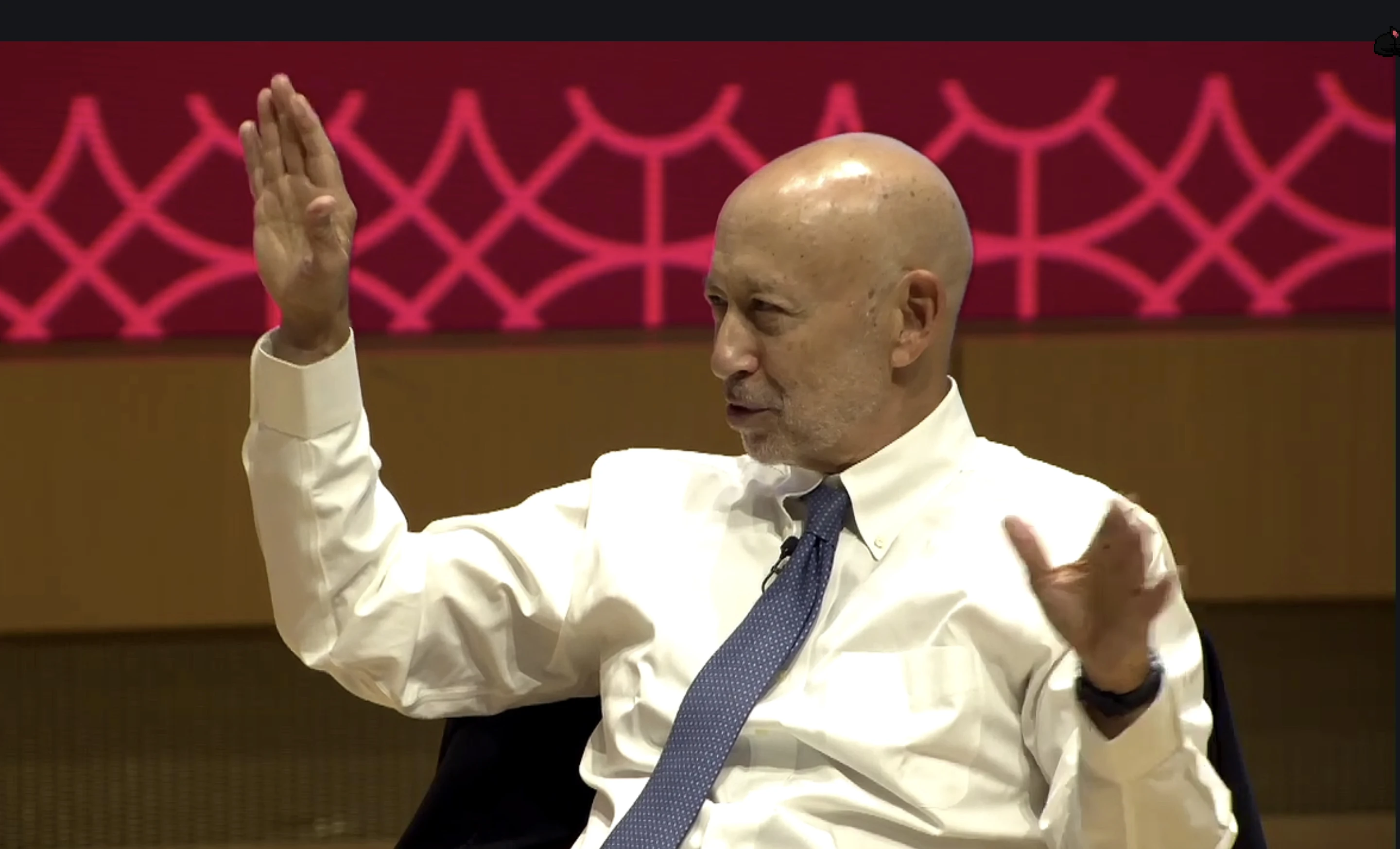
BOSTON — Don't mess with the traditional independence of the Fed. Don't reject tariffs, but don't impose them recklessly. And if you want to address income inequality, do it through a progressive tax, rather than a heavy-handed "wealth tax."
So says Lloyd Blankfein, former chairman and CEO of Goldman Sachs and a veteran of the 2008 financial crisis, at an event hosted Tuesday by Harvard Business School's Institute for Business in Global Society. In a broad discussion that ranged from the “inevitable rise” of China to the dangers of artificial intelligence, Blankfein recalled his tumultuous time leading the financial services giant and offered his thoughts on current affairs.
Without mentioning President Donald Trump by name during his 90-minute talk, Blankfein came down hard against attacks on the independence of the Federal Reserve, which manages monetary policy and sets interest rates. Trump has sought to remove one of the Fed's governors and appoint loyalists to the seven-member board, which has traditionally been apolitical.
“It's terrible on every level,” Blankfein said at the event, the first BiGS Conversation of the year. “It just makes the world more expensive for everyone," because a biased Fed might make politically convenient policies, instead of fiscally sound ones.
“Taking away the Fed's independence and making it another tool of fiscal policy … would diminish its value, just making it more expensive for the U.S. to function in the world,” he said.
A moderate position on trade
Blankfein, whose book Streetwise: Getting to and Through Goldman Sachs will be available next year, gave qualified support for tariffs, which he said are a way to boost salaries for American workers by making U.S. companies more competitive.
“I think part of the polarization of the country has come from the desiccation of the middle class, and the loss of high-paying jobs because we benefited from lower labor costs in other countries,” Blankfein said in a response to a question by host Debora Spar, the senior associate dean for faculty and research.
But Blankfein also said tariffs are essentially a “sales tax,” presenting a burden on American consumers.
A career at Goldman Sachs
A graduate of Harvard College and Harvard Law School, Blankfein recalled his path, including his childhood in Brooklyn, being the first in his family to go to college, and eventually rising to become CEO of one of the most prominent financial services firms in the world.
It wasn't always a smooth road. Blankfein was rejected early on for a job at Goldman Sachs, and only ended up there after it bought the firm that employed him, J. Aron & Company. During his time as CEO during the financial crisis in 2008, protesters taunted Blankfein outside his apartment building in New York.
Goldman Sachs was viewed with suspicion because it didn't lose money during the crisis (but didn't make any, either, Blankfein said). While the public was angry over the failure of the country's leading financiers to avert the crisis, the reality was that they simply didn't see it coming, Blankfein said.
“Everyone was consuming the same drugs and missed it,” Blankfein said, explaining why no one was punished for their role in the fiscal meltdown. But “not only is stupidity not a crime, it's actually a defense,” he said.
‘Anti-system‘ sentiment
Blankfein fielded audience questions about income inequality and polling that shows young people are attracted to socialism and communism. He said it represents the “anti-system” sentiment of a generation unhappy with the status quo.
“I just take it as part of the polarization and the attack on the system that we have today,” Blankfein said.
There's a frustration over the difficulty in paying for basic things like housing — something that explains the rise of Zohran Mamdani, the democratic socialist who is the Democratic nominee for New York City mayor, Blankfein suggested.
“Mamdani has struck a chord, as he should,” Blankfein said. "He's made a contribution if he focuses everybody's attention on the affordability and sustainability of the city.”
As for growing income inequality, that's better dealt with through the existing progressive tax system, as opposed to the “wealth tax” imposed by some European nations, Blankfein said. “We have to do … a better job of distributing the wealth without putting too much of a burden on what we do to generate the wealth,” he said.
“I don't mind the concept behind a wealth tax,” he said. “I don't mind the concept behind communism and socialism. It just doesn't work.”