BiGS Actionable Intelligence:
BELEM, Brazil — The 30th annual United Nations Climate Change Conference, known universally as COP30, took place this week, drawing world leaders, diplomats, scientists, NGOs, company executives and academics together to discuss decarbonization efforts and sustainability.
Roughly 50,000 people from 200 countries attended more than 100 sessions, but it was at a panel Monday on decarbonizing the global food system, a notoriously difficult challenge, that a small revelation held big implications.
In many parts of the world, it is business — not government — that is leading the charge.
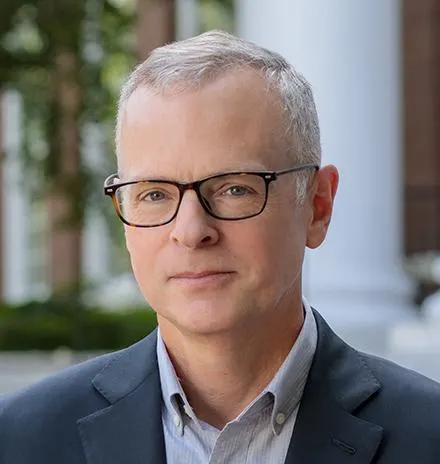
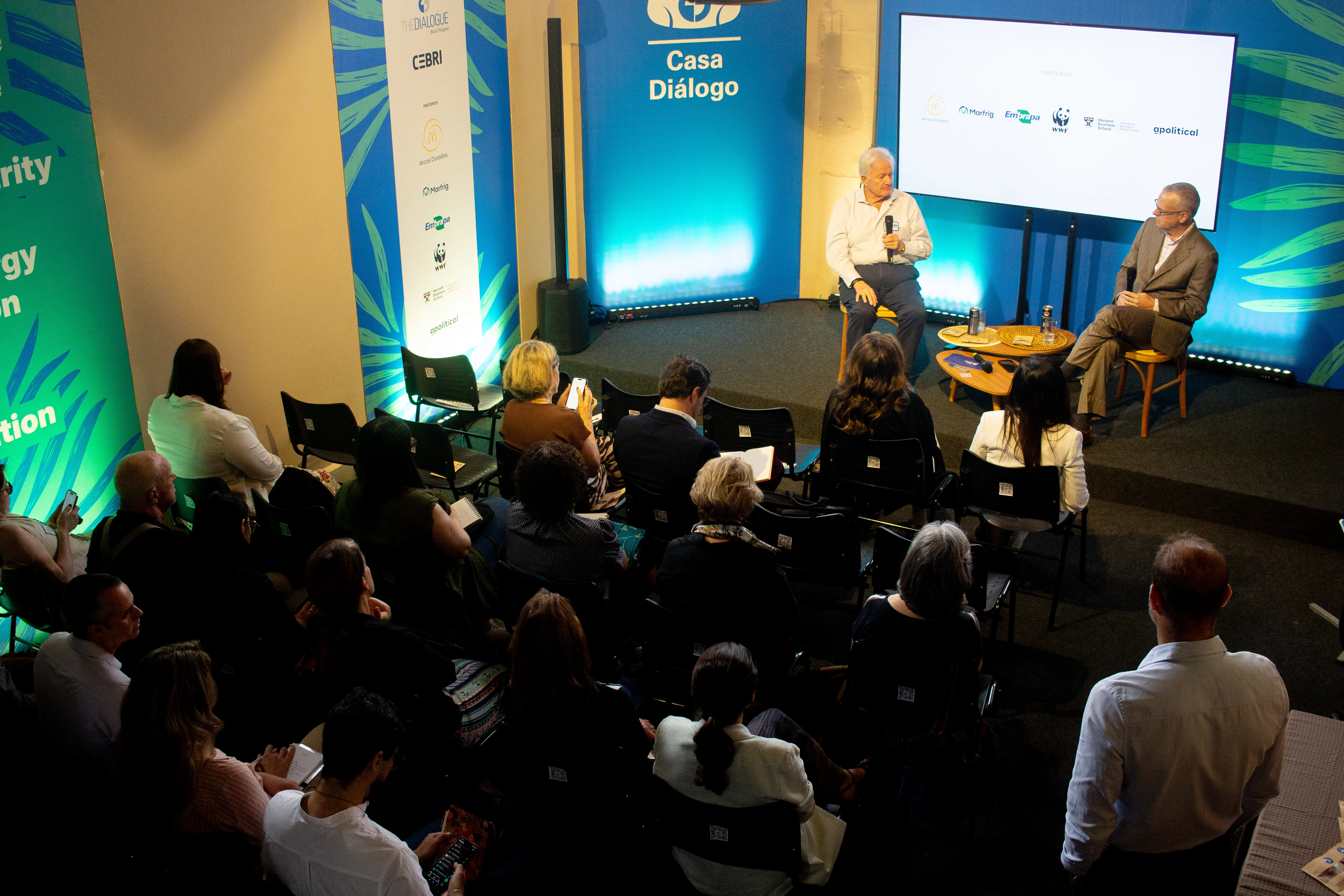
So says Gunnar Trumbull, a Harvard Business School professor who joined Woods Staton, executive chairman of Arcos Dorados, the world’s largest independent McDonalds franchisee, for a 90-minute panel as part of Casa Diálogo’s “Sustainable Agriculture Day,” which featured discussion on how to bridge the gap between ambition and execution in transforming Latin America’s food systems.
The panel was organized by the Brazil Program at Inter-American Dialogue and sponsored by Harvard Business School’s Institute for Business in Global Society (BiGS), Arcos Dorados and the meatpacking firm Marfrig, among others.
“Thirty-three years ago, the Earth Summit in Rio launched the Framework Convention on Climate Change,” Trumbull said. “It’s wonderful that COP is now back in Brazil, because the country is a key part of the global food supply chain. Food is one of the hardest sectors to decarbonize, and companies are now at the center of that conversation.”
“In the early COPs, companies were not even at the table — they weren’t even invited,” he continued. “Now, some of the most important discussions and agreements are being made within the business community. Firms like Arcos Dorados and Marfrig are getting out ahead of regulation, while governments are still trying to catch up and support their efforts in decarbonization.”
Turning purpose into structure and scale
Staton shared how Arcos Dorados, which operates more than 2,400 McDonald’s restaurants across 21 countries in Latin America and the Caribbean, has embedded sustainability into its business strategy.
“We realized that we could create an economic reasoning for being sustainable,” he said. “We started tracking deforestation, auditing the system.”
Staton, who stressed the importance of working with partners that have the same vision and alignment as Arcos Dorados, recounted how the company’s zero-deforestation commitment forced a tough but decisive move.
“When one of our beef suppliers failed to comply, we cut them off,” he said. “It wasn’t easy, but it was the right thing to do. That decision changed how we see our responsibility as a company.”
From that moment, sustainability became a structural priority. “We moved from beef to cups, to paper straws, to eliminating plastic lids. It’s a series of small solutions that have a big impact,” he said. “It made us more aware of what was necessary.”
Trumbull said the company’s most challenging emissions are upstream, the so-called “Scope 3” emissions that come from the supply chain. In this case, that means beef production. Staton agreed, adding that the company pays “between 15% and 20% more than competitors” for sustainably sourced beef.
“It’s the right thing to do,” he said, adding that, despite the extra cost, the effort pays off. “In the last five years, we’ve gained market share.”
Balancing profitability and purpose
Despite the higher costs, Staton said sustainability and competitiveness can reinforce each other.
“We report quarterly, but good businesses take the long view,” he said. “We’ve remained profitable and grown our market share while investing in decarbonization.”
Staton pointed to practical examples where sustainability improved efficiency. “We’ve switched to renewable energy contracts—they’re cheaper than buying from the grid,” he said. “And we capture water from our air conditioning systems—300 to 500 liters a day per restaurant—for reuse. It costs a bit more to build, but it saves much more.”
The company’s agile approach has allowed it to innovate quickly. When the city of Rio de Janeiro banned plastic straws, Arcos Dorados decided not to resist. “We didn’t fight it,” Staton said. “We just adapted. Within months, we eliminated plastic straws across all 21 countries. And we discovered that our customers did not mind. We’ve saved about 4,000 tons of plastic a year—and saved money too.”
Trumbull highlighted how such moves illustrate a broader transformation. “Fifteen years ago, people thought startups would disrupt the world,” he said. “But it’s large, established, iconic firms like McDonald’s that are coming up with creative solutions and deploying the capital to decarbonize.”
Collaboration for a new industrial strategy
Both Trumbull and Staton emphasized the need for closer alignment between the private sector and public policy.
“AI is helping us reduce emissions,” Staton said. “We use it for logistics, routing, inventory—all of which makes us more efficient. But we also need governments to work with us. They shouldn’t act like police. They should set sensible policies and test them with companies like ours.”
Trumbull agreed, noting that regulators themselves are undergoing change. “In Europe, competition authorities are being told to let companies collaborate on standards for decarbonization—something that was once unthinkable,” he said. “Regulatory agencies are learning to work differently.”
That challenge is central to an initiative that Trumbull co-leads, the Green Industrial Strategy Project, a collaboration between BiGS and the Berkeley Economy and Society Initiative (BESI) at UC Berkeley, with support from the Center for Innovation and Sustainability in Business. “Our goal is to start with the challenges that firms face in decarbonization, and then design the regulatory frameworks that can actually support them,” Trumbull said. “Like businesses, regulators are having to rethink their culture and build new technical capabilities.”
The conversation also touched on the global role of Latin America in the low-carbon transition. “Brazil and its neighbors are central to agriculture, mining, and renewable fuels,” Trumbull said. “Coordination through supply chains—rather than carbon markets—has become an important part of the new model for global decarbonization.”
Staton agreed, adding that the region’s leadership in sustainability is as much ethical as economic. “We have to take care of the planet,” he said.
Staton also underscored the social dimension of the work at Arcos Dorados. “We hire young people and help them pay for their education,” he said. “In Brazil, for many of our employees, the meal they have at work is the only one they’ll have all day. For most, it’s their first job, their first bank account, their first tax payment. Once they work for us, they have formal jobs, and they enter the system. That makes them better citizens—and that’s part of sustainability, too.”