BiGS Actionable Intelligence:
Editor's note: This exclusive interview with University of Southern California Assistant Professor Kalinda Ukanwa marks the second in our six-part series exploring the crucial intersection of technology and inequality, based on Harvard Business School's invitation-only summit, Inequality in the Digital Age. On March 8, 2024, Harvard Business School Associate Professor Michael Luca and the Race, Gender & Equity Initiative convened economists, psychologists, and other scholars to explore how the latest technology boom is reshaping today's world. As part of our ongoing commitment to sharing evidence-based insights, The BiGS Fix Editor-in-Chief Barbara DeLollis engaged in candid conversations with six distinguished scholars on the sidelines. We've edited the transcript for length, clarity, and style. Stay tuned for more and be sure to join our growing LinkedIn community!
Q. Thank you for sitting down with us today. You were researching algorithmic bias and fairness in AI systems long before the current boom. Why do you care about this rapidly evolving technology?
A. I have been studying this [general area] for the past 10 years. As a Black woman in society, I have a personal interest in ensuring that the allocation of resources through artificial intelligence will work just as effectively for me as it would for anybody else. Why is this important to society? Because I think everybody wants to be treated fairly. In response to AI, which is meant to mimic human thinking, we want to make it in a way that it doesn't replicate some of the things that we can do a whole lot better.
Q. Can you give an example to contextualize where we are with this so-called AI revolution?
A. The analogy I like to use is the emergence of the automobile, when suddenly people found that there was a new technology that could help them get farther, faster, than ever before. But at the time that it was invented, there weren't things such as stoplights, seatbelts, etc. Along the way, we came to learn that there can be harm that comes from this, (but) we still wanted to use the automobile. The same can be said about AI. How do we make it safer, more usable for everybody, so we can extract all the benefits there are in this new technology?
Q. Does the pursuit of profits influence algorithmic bias?
A. In my research, I find that ... over the long run, it's going to be less profitable to have an algorithm that can produce bias. Why is that? Because it impacts what people say. If it impacts what people say, they spread it to others. And over time, people learn to stay away from that firm, even if they are not sure exactly how the algorithm works. And that influences demand over time from a firm that has a fair algorithm. I show that in the short run, it might be more profitable to have a biased algorithm, but in the long run, it's unprofitable.
Q. You’re visiting Harvard Business School to present your new work exploring bias in AI to your colleagues. Tell us more.
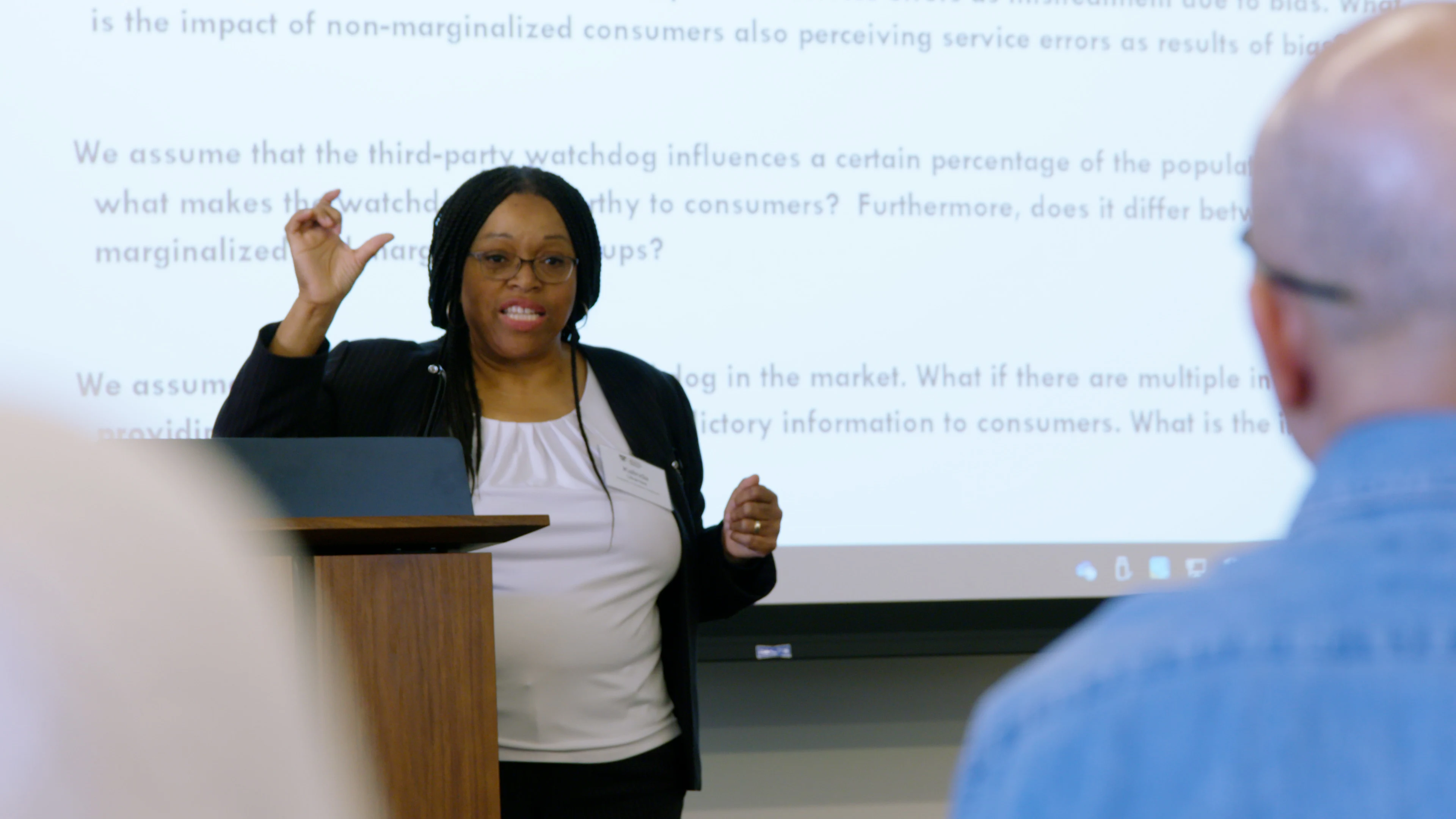
A. Today, I'm going to talk about the impact of artificial intelligence and the potential beliefs about bias that it might generate. How does that impact consumers in terms of the beliefs they form about the algorithms? Could that possibly spread over a population? And does that influence what consumers do in terms of their decision-making? So, I'm examining that diffusion of this unfair belief and how does it rise, and is it always about a biased algorithm. I show conditions where unfair beliefs can emerge even in the absence of algorithmic bias. And then I look at the effects of a third-party intervention that informs consumers about the algorithm's bias status. What are the implications for consumer beliefs and for firms utilizing algorithmic services?
Q. You’d mentioned that this research was partly inspired by a 2019 Apple product launch. What’s the story?
A. When the Apple credit card was launched, there was an initial surge of belief suggesting bias against women, whether in obtaining the card or receiving adequate service. These beliefs, sparked on Twitter, quickly spread across various media platforms. However, when media was brought in, and investigations were done, it turned out there was no evidence of bias in the algorithm.
And so, you know, it leaves this question of how this belief ignited if there really wasn't a bias, assuming that they assessed it correctly. This is one of the inspirations for this work.
Q. What are some key takeaways for Apple and other firms based on your research?
A. One, it's important to manage not only the bias and algorithm, but also other random errors the algorithm may produce — which might not have anything to do with bias — because it could potentially trigger beliefs and behaviors with consequences for businesses and social groups.
Two, we find that if the algorithm is biased that it can actually accelerate the beliefs far more than what people realize.
Three, the existence of a third-party watchdog, similar to a Consumer Reports, that could evaluate algorithms and disseminate [algorithms’] performance could have the dual effect of reducing the spread of biased beliefs among fair firms and increasing awareness of any existing bias. [It could act] as a beneficial tool of accountability for both companies and consumers.
Q. Why do you recommend third-party intervention to protect society?
A. Because the core theory in my research is that consumers and firms don't assess fairness in the same way. We're putting forth that consumers assess the fairness of firms by talking to their friends and family. They don't have access to all the data that the firm might have. Nobody does. It's not publicly available. They don't have access to how the algorithm is designed. Again, that is not publicly available.
On one hand, firms may be managing fairness in their AI algorithms based on specific criteria, which can differ from people's perceptions, potentially leading to conflicts arising from these distinct interpretations of fairness. Having a third party capable of realigning information between the firm and consumers can, then, lead to better outcomes.
Q. What type of institution could fill the role of “third party?”
A. In the research, we don't specify what the third parties should look like, but in my opinion, it would have to be somebody that's considered objective, at arm's length, [with] no conflict of interest. It would have to be an entity considered credible by firms as well as by both marginalized and non-marginalized populations for it to work. Could it be something like a government if there's credibility that is found within the population? Sure. Could it be media? It depends, but I think that the level of trust and credibility has to be there from both sides for it to work.
Q. Why should business prioritize keeping their algorithms fair? Are there sufficient incentives?
A. Sure, and some of my research shows this. A body of my research is geared toward looking at the downstream consequences of algorithmic fairness, algorithmic bias, and the economic impacts on firms and their decision-making. So, I for sure, as a result of my research, think there are economic incentives.
Q. There’s so much we don’t know about AI, which must make this a rich area for scholars like yourself. What do you think is next on the research frontier?
A. There are many research frontiers around here. This question about the broader class of responsibility — which is an emerging area of research that includes questions about fairness, questions about privacy for citizens, questions about safety, the algorithm, questions about accountability, transparency, trust — is a really rich area for new, innovative research.
And it's cross-disciplinary. We need to hear from sociologists, psychologists, philosophers, ethicists, in addition to the research that we have now, which is computer scientists, myself and economists, and statisticians. We need to hear, ‘How do we need to do this so that it's beneficial for society?’
Q. As debate rages on whether AI will ultimately be good or bad for society, where do you land on this question today?
A. I believe AI is good for society at the end of the day — it has so much promise. But it also has some perils. We just need to manage the perils as we develop the promise.
Q. What advice do you have for the CEOs, chief marketing officers, chief information officers, chief human resource officers, and others who are making big bets on AI in 2024?
A. Many see this as a new toy that’s going to innovate, jumpstart, and move their organization forward with leaps and bounds. It does have that promise, but decision-makers in the room really need to think it through.
How do we manage this new technology, using the analogy of the car, to avoid starting up the new car and just going, and instead think about how we avoid hitting people in the road? How do we avoid tumbling off the cliff? I hope they would think through those things before it is too late for that.